A report by Daniel Andriani, translated from an imaginary language into English by Toni Wehn
What Is the Predatortour?
The Predatortour is an international predator fishing competition that has been held once a year since 2009, at the end of May. European predator anglers go head to head from the boat, targeting pike, perch and zander.
Venue
The competition takes place in the Rhine-Meuse Delta in the Netherlands — specifically on the Hollands Diep and the Haringvliet. Each year, the starting signal is given beneath the bridge at Europarcs Resort Biesbosch, where the competitors' boats are also moored.
Competitors
All teams fish from the boat in pairs. Since Toni has (so far) no interest in competitive fishing, I looked for a partner for the Predatortour and quickly found a strong angler in Roman from Rheinland-Boote/Bullseye Fishing, who was keen to fish alongside me. A total of 120 boats — 240 anglers — took part, including YPC competitors Enrico Di Ventura for Westin (runner-up in 2018), Didi Isaiasch for Quantum, Herbert Ziereis for Fisch&Fang, and Jan Pusch for Mercury (runner-up in 2017), as well as friends such as Johannes Dietel for Shimano, Pierre Johnen for Spro (champion in 2017) and Ugis Gross for Zielfisch. The field could hardly have been stronger.
Format
There are three consecutive competition days (Thursday to Saturday), with fishing from 08:00 to 16:00 each day. Teams can submit up to three pike, three zander and three perch for scoring — all of which must be caught on lures. Trolling is permitted. Zander only count once all three pike have been caught, and perch only count once all three pike and all three zander have been landed. Any team that catches all nine scoring fish earns 1,000 bonus points and secures qualification for the following year's event.
Preparation
For this year's competition season, thanks to a partnership with Rheinland-Boote, we had a truly exceptional boat at our disposal: a Ranger VS1782 with outstanding kit from Humminbird, Minn Kota and Talon. The boat needed collecting, running in and getting to grips with — and of course we had to learn the water. I had fished the Haringvliet the previous year, but the Hollands Diep was completely new to me. Since Roman was still heavily tied up with work, Toni — who at least knew a few spots on both waters from the YouTube Predator Cup — came along to help with training and to test a few new lure prototypes.
We captured the final day before the tournament in a short, informal video:
Day One
As the weather forecast pointed to this being the windiest day of the competition, the plan was to start on the nearer spots on the Hollands Diep and target our three scoring zander first. Roman and I headed to the marks we had worked out with Toni during training. We both jigged for zander, and after a little while we had our three zander on board, along with a very welcome bonus perch.
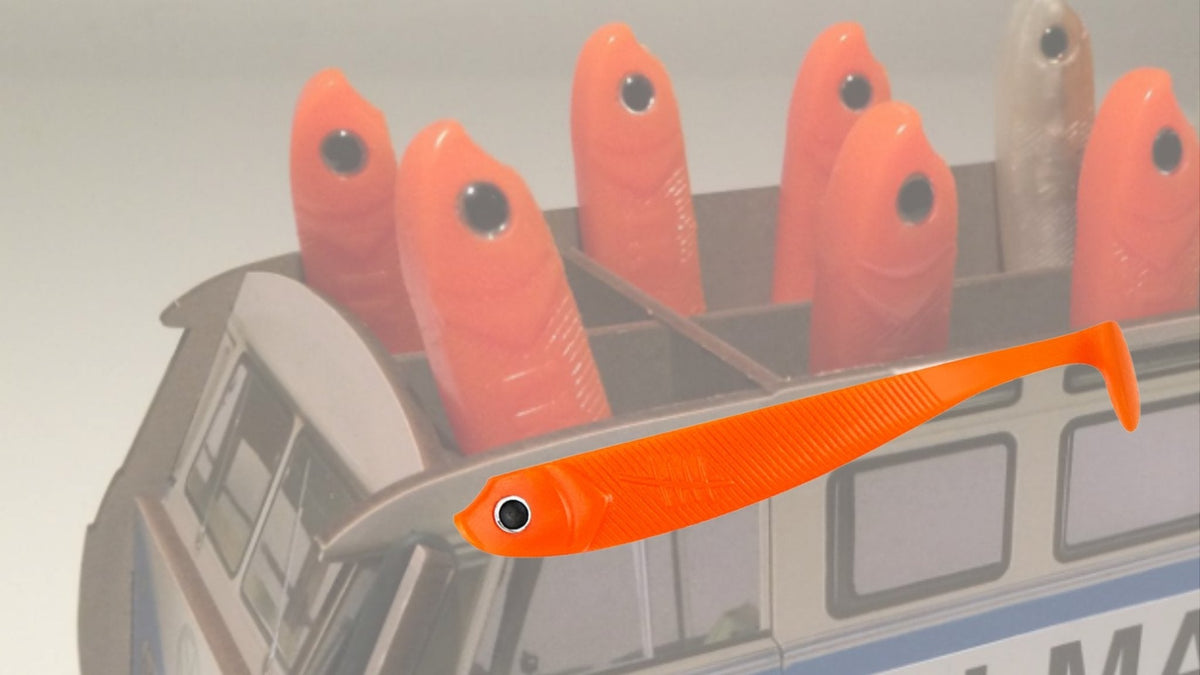
With roughly two hours left, we moved to a pike spot and managed to put one small esox on the scoreboard on a spinnerbait. Five of the nine fish were done. Because we hadn't yet completed our three pike, the zander and perch didn't count yet, which left us well down the standings — but that didn't bother us. The lure of the day was a KØFI Barsch (11 cm) in the prototype colour Natural Perch, which accounted for all three zander. That colour had already been a standout during training and will be available in the shops come autumn.
Day Two
The mission was clear: we needed two pike and two perch. The day started in demoralising fashion — as soon as we arrived at our pike spot, Roman lost a metre-plus fish at the boat, and shortly afterwards I dropped a pike around 70 cm. It took a moment to shake that off, though it wasn't long before two small pike on jig spinners at least completed our three scoring pike.
Then we went after perch — arguably the most difficult target species of this year's competition. Even during training, plenty of anglers had struggled with the perch, and it was no easier for us. We worked through several spots, managed just one perch over the course of hours, plus a pike and a zander that each nudged our score upwards. The third perch refused to show for what felt like an age, but switching to drop shot brought salvation 17 minutes from the end (see photo).

That fish earned us not only the 1,000 bonus points but also qualification for next year. We then rushed back to our zander spot from the day before and, still on the drop shot, put three more zander in the net in quick succession — two of which gave our score a slight boost.
That moved us up to 47th place in the standings, though we knew that many teams would reach their bonus points on day three. To hold or improve that position, we needed at least two good pike on the final day. A big perch wouldn't have gone amiss either. The lure of the day was a KØFI Ukelei 15 cm in Electric Chicken on a drop shot rig.
Day Three
The final day is quickly told. Conditions for our plan to target big pike could hardly have been worse. It was almost completely calm, the pike were off the feed, and we — like many others — were largely on a hiding to nothing. Whatever we tried — big lures, small lures, soft lures, plugs, spinnerbaits, jig spinners — no pike showed any interest. It was the last Predatortour at which trolling was permitted; in hindsight, perhaps we should have given it a go. As it was, we caught just two fish on day three that improved our score: one perch and one zander (again on the KØFI Ukelei on the drop shot). We slipped back to 70th place.
Prize Giving & Final Thoughts
As early as day two, the French pair Lionel Chevalier and Tristan Poulain had put together a scoreboard that left most of the field speechless. They improved only marginally on day three, but it didn't matter — they had done more than enough to take the title. Three perch over 46 cm, pike between 95 and 111 cm, and zander from 64 to 89 cm made up the highest-scoring result of the competition.
Second place also went to France. The Hernandez brothers, Kevin and Jordan, landed no fewer than three pike over the metre mark; their perch were also very strong at 42 cm to 47 cm, but compared to the winners they lacked one big zander. Nils Gabsa and Marcel Asbroek, who had gone into the end of day two without a single perch, caught the three they needed just in time and climbed to third place, driven largely by an average zander size of 73 cm and a 125 cm pike.
Among our friends, Herbert Ziereis fared best — the YouTube Predator Cup competitor and his partner Birger Domeyer finished 6th. Dietmar Isaiasch caught the biggest fish of the tournament at 125.7 cm (see photo); he and Daniel Katzorek finished 15th. Jan Pusch and Daniel Brce came 29th, while Enrico Di Ventura and Frank Bußmeyer landed in 47th — a strong result by any measure, but certainly not the one the ambitious Enrico had been aiming for.
Perch specialist Johannes Dietel, undisputedly one of Germany's finest anglers, and Shimano team angler Olli Gumbel — aboard arguably the fastest boat in the field — finished just 116th out of 120. Over three days they failed to land a single perch, despite having caught plenty in training. A reminder, if one were needed, that fishing can never be fully calculated and the fish always have the final say. You can find the full results HERE.
Summary
Looking back, it felt as though more had been possible after day two — though that's probably what you tell yourself almost every time. On balance, we achieved our main goal of qualifying for next year without too much trouble, learned a great deal and came away genuinely fired up for the competitions ahead. At the end of June I'll be back on these waters, fishing the WPC alongside Frédéric Jullian — this time with cameraman Juli on board. Hopefully there'll be some exciting videos to look forward to!
Until next time!
Your Daniel