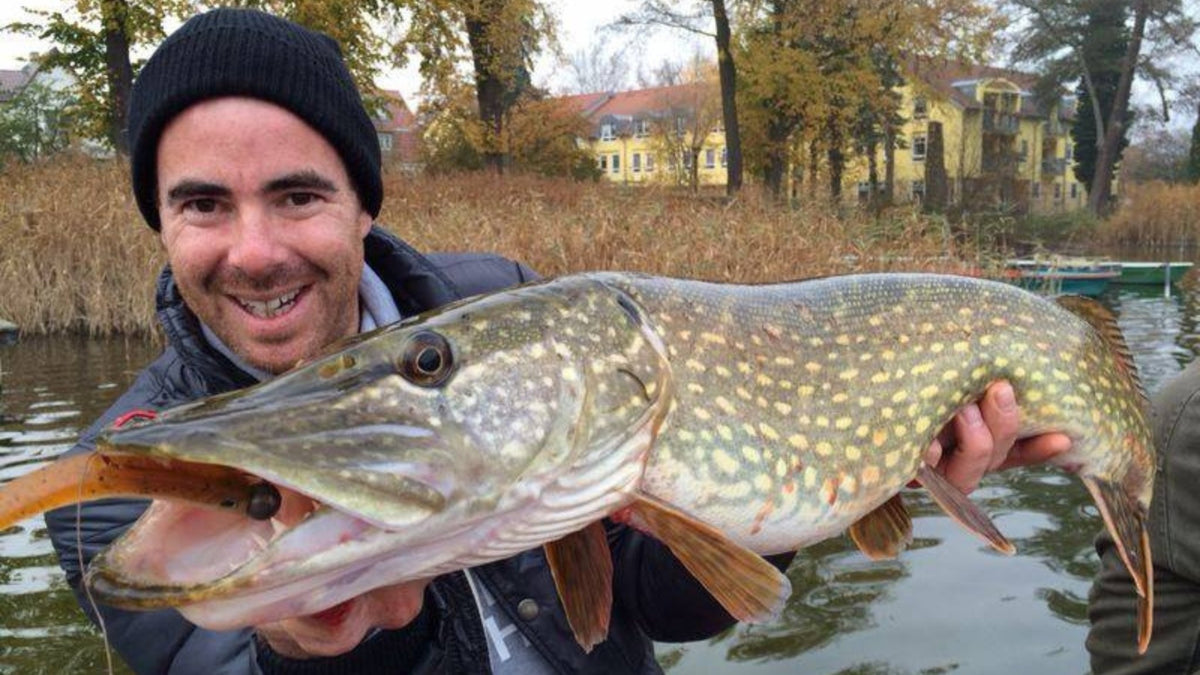






There are several techniques you can use to catch zander successfully. Particularly popular are jigging and the 'lazy' retrieve method, which use a similar rig but differ fundamentally in how you work the lure. You can also try the Carolina rig or drop shotting. We cover all of these methods in this article.
Getting Set Up
I use a relatively stiff rod with a tip action — a Shimano Shadow Diaflash rated 0–30 g — paired with Spiderwire Invisi Braid at 0.17 mm. At the end of the main line I attach a small swivel, with around 50 cm of mono on the other side. This keeps you in excellent contact with the lure while presenting a well-disguised rig.
You can tie your lure directly to the mono or add a small cross-lock snap swivel in between.
The weight of the jig head depends heavily on the depth and current. On my home water, the Havel, I mostly use heads between 12 and 16 g.
Zander Methods at a Glance
Jigging
At first, jigging for zander can seem tricky to coordinate. In my view, it is the most active and most demanding of all lure fishing techniques.
After casting, wait until the lure hits the bottom and your rod tip is pointing down towards the water. Then give a sharp upward sweep so the lure rises about 50 cm off the bottom and the rod tip reaches roughly 60° above horizontal. At that point, wind quickly to take up the slack so the rod tip drops back towards the water.
The challenge is maintaining constant contact with the lure so you feel every bite immediately. As you practise this technique, be careful not to sweep the rod — and with it the lure — too high. Jigging can be harder to recommend when zander are really feeding hard, which typically happens in the summer months just before dark.

The Lazy Retrieve
Most anglers get to grips with the lazy retrieve far more quickly. It is the most widely used method for catching zander, and the name says it all: apart from the cast and playing the fish, the rod stays completely still at all times, tip pointing towards the water.
After casting, wait until the lure reaches the bottom — you can tell because the line goes slack. Give the reel a few turns, then pause again and let the lure sink back down. Because the rod angle stays constant, the lure moves at a fairly shallow angle and stays close to the bottom throughout. Wind slowly and keep your retrieve phases short, giving every zander the chance to commit.
Carolina Rig
The Carolina rig originated in the USA, where it is mainly used for largemouth bass. I spent several years fishing for largemouth bass in Zimbabwe and used the Carolina rig extensively. Since moving to Berlin I have stayed faithful to it, and it has accounted for some fine zander and perch.
The retrieve is very similar to the lazy method, but the key difference lies in the rig itself: with the Carolina rig, a bullet weight runs freely on the braid, and a swivel at the end of the braid — between the braid and the mono — stops the weight sliding down to the hook.
A glass bead sits on the braid between the weight and the swivel, producing a tempting 'click' sound when the weight strikes it. I run around 70 cm of 0.3 mm mono as a leader and use a barbless offset hook.
There is a wide range of lures that work on the Carolina rig — many have long, crayfish-like profiles that create plenty of movement in the water. In strong currents I would really recommend the Carolina rig; just make sure you work the lure very slowly.
Drop Shot
For this rig I again connect around 70 cm of mono to the braided main line using a small swivel, then attach a dedicated drop shot weight to the end of the mono. About 40 cm above the weight I tie the offset hook directly to the mono using a Palomar knot. You can use purpose-made drop shot lures, but my best catches so far have all come on standard jig-style soft lures — the Lunker City Grub in particular has been outstanding.
After casting, wait until the weight touches the bottom. From there, very gentle twitches of the rod tip are enough — just keep the line taut throughout.
When retrieving, do everything extremely slowly. The real advantage of drop shotting is that you can hold the lure in the same spot for much longer, because the weight sits on the bottom below it.
With zander you normally need to strike immediately on a bite, but with the drop shot it is better to wait a moment before striking.
Summary
I hope these tips have been useful. One thing I can say with confidence: the more variety you bring to your fishing, the more fun it becomes — and the more fish you catch. I look forward to your feedback and comments.
Until next time — tight lines!