






We're delighted to share another article by Marco Solar. He and his friends have already been on quite a few hunts for this saltwater predator, and in this blog post he's happy to share his experience and extensive knowledge about sea bass. Where are the hot spots — including beyond Germany's borders? What tackle do you need, and which method works best where? Enjoy the read!
What Is Sea Bass?
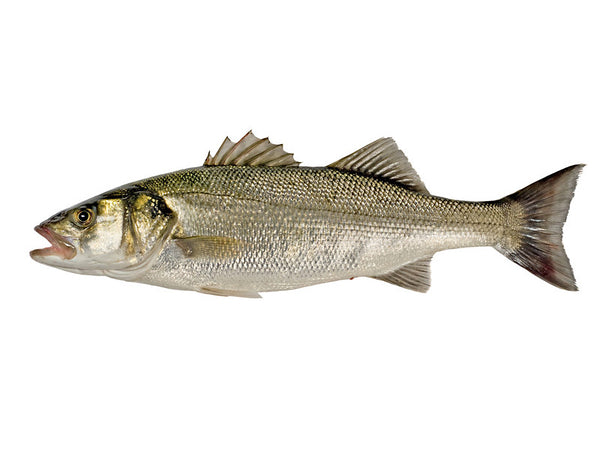
A sea bass (lat. Dicentrarchus labrax) is a remarkable sport fish and a highly sought-after table fish. Many anglers also know it as Seebarsch. Chefs like to call them 'Loup de mer', while in England the name is simply 'Sea Bass'. The days when a sea bass in these waters was nothing more than an occasional by-catch are well and truly over. Sea bass are on the advance along all coastal areas of the North Sea, the Atlantic and the Mediterranean — partly thanks to EU measures to protect threatened species.
 Fishing for sea bass is a real sport, and with modern methods you can get results quickly. A sea bass in saltwater won't simply drop into your landing net. It's similar to targeting large pike or zander: you have to learn to read the water and figure out which lure options work. With every session you get better at turning your own experience into productive outings.
After reading this post you'll realise that your next sea bass hot spot could be closer than you think. Hardly any angler will willingly give away their favourite spot. The secret is simply to keep your eyes open. You'll often see anglers with lure fishing gear working rock formations or interesting corners of harbours. The trick is finding the local spots quickly.
Everything You Need to Know About Sea Bass
Range and Spawning Season
The sea bass has a wide and varied habitat. They range from Morocco in the eastern Atlantic all the way north to Norway, from the Black Sea across the Mediterranean and far into the North Atlantic. In summer the fish favour coastal waters; in winter they head for the open ocean. Sea bass are equally at home in the brackish water of river estuaries.
Spawning takes place between January and March, and the spawning season runs from May through to August. A sea bass of around 60 cm is roughly 12 years old. They reach sexual maturity at around five years, by which point they've typically reached the average minimum size for sport anglers of around 40 cm. Avoid unnecessary removal and stress for young fish — as a rule that goes for all fish — because a sea bass of 20 cm is barely two years old and needs a few more years before it can spawn for the first time and help secure the future of its species.
No-Kill Regulations in Europe
Since 2018 a clear new regulation has been in place for sport anglers across Europe regarding the retention of sea bass. One thing worth noting up front: there are anglers who are technically permitted to keep several sea bass per day, yet choose to follow a strict no-kill approach in order to support those fishing above the virtual retention boundary.
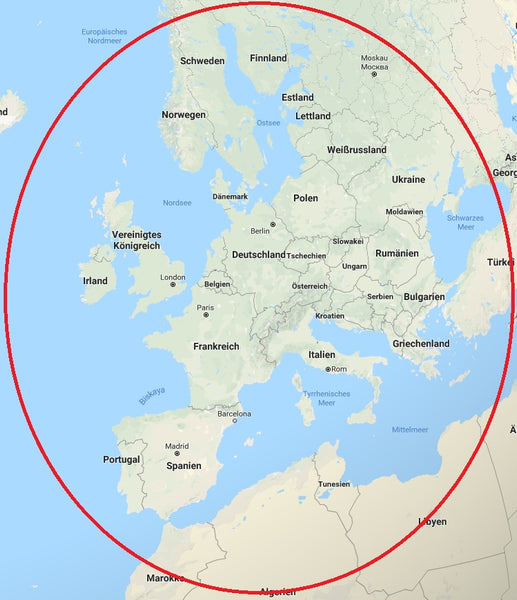
Anglers below the 48° line of latitude may retain 3 sea bass per day. Above that line, 100% catch and release applies year-round for all sport anglers. Commercial fishermen must observe a two-month ban on catches so that sea bass can gather undisturbed during the spawning period. The 48° parallel runs just south of Brest and St. Malo in France. No-kill means catch and release.
Catch and release — by now a widely accepted practice that lets us return the fish to the water as carefully as possible.
Update October 2018 — Holland:
From now on, one sea bass of legal size may again be retained per angler per day. From 2019 the limit may be raised further. Overall there is to be an open season of 8 months for sea bass fishing in Holland. The Dutch angling federation's website carries up-to-date information on all new rules: Sportvisserij Nederland | Zeebaars 2018.
Here is a link with detailed information on the new regulations for sea bass fishing in the various European countries, along with a map of the retention boundary.
The minimum size is around 40 cm in most countries — with the exception of the French Mediterranean coast, where sea bass of just 30 cm may theoretically be retained. Always check the local fishery regulations. In Ireland and Holland, for example, there is active on-the-water enforcement. Inspectors follow strict rules and will not enter into any discussion.
Sea Bass Hot Spots
Sea bass are true saltwater predators. They love hunting small fish, even in the dark, and they don't shy away from strong currents, shallow water or calm stretches. As a rule, though, they prefer coloured water — for instance shallow surf beaches where waves are breaking, or clear water in bays. These are the hunting grounds of sea bass.
England has always been right up there when it comes to both the frequency and size of sea bass caught — whether you're fishing from a boat or the bank.
Germany also offers plenty of good opportunities for targeted sea bass fishing. Techniques differ somewhat between the North Sea and the Baltic. On the Baltic it's generally calmer, and sea bass are even targeted with a fly rod and large saltwater flies. On the German North Sea coast you need slightly heavier tackle, as the current and tides call for greater weight and larger baits.
Sea Bass from the Beach
If you have a long stretch of beach without obvious features in front of you, look for isolated stone structures or similar irregularities — that's where the sea bass hot spots are.
North Sea
The North Sea has wooden pilings, rock dumps, groynes, breakwaters and much more. There are almost always a few sea bass holding around these features. Current is also your guide to the big sea bass: wherever you see water running in or out between two sandbanks, don't walk past without fishing it.
Atlantic
Along the Atlantic coast of southern France, sea bass are often caught right in the heart of the heaviest 'breaks' — the spots on the beach where the largest waves crash. In summer you'll be competing with surfers for these spots, so it's worth revisiting them in winter.
Local sport anglers fishing in the surf here don't wear waders — at the sometimes enormous wave heights the risk of them filling up is simply too great. Instead, like the surfers themselves, they wear a neoprene wetsuit and a pair of water shoes. So you can sometimes see nothing but a head, a fixed spool reel and a rod sticking out of the water — quite a sight. This technique lets you get very close to the fish and cast right into the broken waves where sea bass are hunting.
The best spots for surf fishing for sea bass are in the south of France, right on the Atlantic coast. Beach fishing for sea bass in Holland is also very worthwhile, and the beaches of the Algarve coast in Portugal are worth a visit at any time of year.
Rocky Coastlines and Cliffs
If you have a rocky coastline — perhaps even with a cliff or two — you can barely go wrong. Big sea bass fatten themselves up along these steep stretches of coast, which offer plenty of cover. Often the best spots are only accessible by boat with a highly experienced skipper. Cliff fishing for sea bass demands serious caution. If you're attempting it from the bank, proper footwear is essential. When in doubt, follow an experienced angler and always keep one eye on the incoming waves.
As soon as the water starts to rise and the tide comes in, start making your way back — or at least keep your escape route in sight. It disappears faster than you'd like.
The most famous cliff fishing locations for sea bass are the waters around Ireland. From Newport to Baltimore you'll find an almost endless number of excellent spots for catching large Atlantic sea bass. Many harbours have charter boats and guides who specialise in 'Sea Bass Trips'. The cliff and rock coastlines of Great Britain and Portugal are also top sea bass venues.
Harbours and Sheltered Spots
Alongside beaches and rocky coastlines, harbours are another great option for targeting sea bass. In the Zeeland region of Holland, there is the little-known Sloehaven at Vlissingen. Admittedly a large part of it is off-limits, but the spots where you can reach the bank as an angler are absolute sea bass goldmines. That said, a word of warning: you'll sometimes encounter shoals of very small sea bass actively feeding here — move on and let the small ones grow for a few more years. Harbours and other well-sheltered locations are home not only to large sea bass, but also plenty of small ones.
Be fair and leave the baby sea bass in peace.
In a harbour you can watch sea bass hunting particularly well. Where a small shoal of baitfish was circling just a moment ago, suddenly only a large bow wave remains. A genuine lure angler has an eye for feeding fish — hopefully within casting range. Outflow pipes, pumps and stone structures with a good covering of algae are the crown jewels among the sea bass spots a harbour has to offer.
A sheltered inland sea with brackish water, or a bridge with tidal surge barriers, also counts as a protected stretch. You may, however, have to contend with very strong currents at the inflows and outflows. In return, most of the water is sheltered from the wind and produces only small waves.
Here are a few hot spots and tips for you:
The Sloehaven at Vlissingen in the Zeeland region of Holland. The brackish inland waters between Zeeland and North Holland. In England, the harbour at Portsmouth and the nearby Isle of Wight are among the best sea bass venues. On the Atlantic coast, Tarifa in Portugal has established itself as an excellent base.
Sea Bass in River Estuaries
The fourth — and very productive — option for catching a large sea bass is river estuaries. The current, the tides and the enormously varied bottom structure are a dream for these fish. Food is plentiful and fishing pressure is very low. Almost all European river estuaries are closed to commercial fishing. Often a small boat with an experienced skipper is the only way to reach the feeding grounds of the sea bass.
In Germany, the following estuaries are worth exploring:
- Westerschelde
- Ems
- Elbe
Internationally, a trip to the Bassin d'Arcachon or to Anglet on the River l'Adour in France is worthwhile, as is the Po Delta in Italy. Large sea bass are, incidentally, just one of many predators you can catch in river estuaries. A river delta is always a hot spot for a variety of predatory species.
Techniques and Tackle for Sea Bass
When you're targeting sea bass, a single rod-and-reel setup will cover a wide range of spots. Of course, your rigs will change depending on the spot and situation, but the core tackle is refreshingly simple. A fairly powerful rod — such as the Shimano Beastmaster EX Spinning 300 XH or the Gamakatsu Akilas100 XXH — paired with a good reel. Don't go too heavy on the line: 0.30 mm to 0.35 mm is generally enough. Heavier line and rods are only needed when cliffs or rock features prevent direct access to the water.
Reel
The ideal reel for targeted sea bass fishing is a high-quality, smooth-running fixed spool reel. It's important that the reel is suitable for saltwater use — salt can quickly attack an ordinary freshwater reel. Whether you prefer braid or mono is ultimately a personal choice.
If you do start out with a freshwater reel, make absolutely sure you rinse it thoroughly under running fresh water after every session and re-grease it. If you're fishing the sea regularly, a saltwater-rated reel is highly recommended.
Landing Net
A telescopic landing net, a sturdy boat net or a round landing net on a cord is always a sensible addition. Depending on where you're fishing, you should always have a way to land your fish as safely and gently as possible.
Fishing Technique from the Beach
From the beach you have to earn your sea bass. You can certainly fish with bait and accept sea bass as a by-catch, but actively seeking out the hunting grounds of the big fish and working them with lures is by far the more effective approach when you're on a stretch of beach with few obvious features or structure.
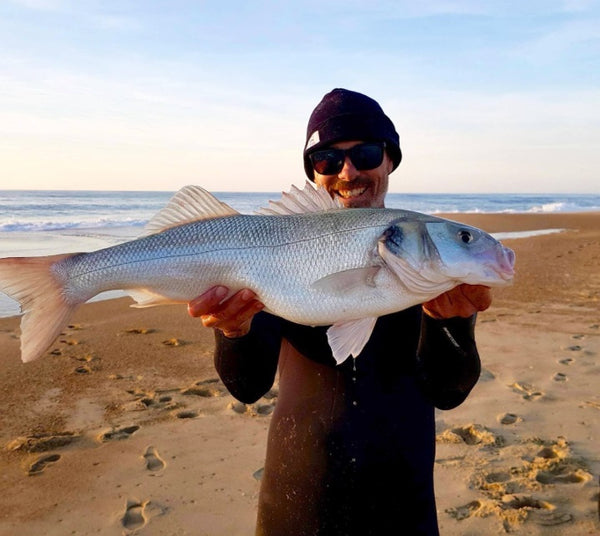
Sea bass from the beach in France. Even though a dark back contrasting with a white-silver body is considered characteristic of sea bass, the occasional stunning silver torpedo like this one does show up.
Surf Fishing for Sea Bass with Bait
If you want to catch sea bass while conventional surf fishing with natural bait, lugworms, ragworms, sand eels or small baitfish are a great choice. Just like our European perch, sea bass love worms. A whole or half ragworm — or alternatively a sand eel — on a single hook on a paternoster rig is always effective. Experienced anglers secure the worm to the hook with a short piece of plastic tubing, keeping the bait in place even on long casts or in strong tides. Baitfish are better presented on a single-boom rig.
In Ireland, England and Portugal, small baitfish and sand eels are the go-to baits for targeted sea bass fishing. In Spain and along the French Atlantic coast, as well as on the North Sea coast of Belgium and Holland, you'll see more anglers using lugworms and ragworms to go after these hard-fighting predators.
Surf Fishing with Lures
Targeting sea bass from the beach with lures takes persistence and, above all, belief. If you don't genuinely think that a fat sea bass could be hunting in the surf just a few metres from your feet, it's hard to stay motivated long enough.
With enough motivation and the right lures, you will be rewarded — it's only a matter of time.
Even the fishing guides in Holland and France had to convince me at first. In Holland I was getting bites on sandbanks that had only been covered by the rising tide for perhaps 10 minutes. The sea bass move onto the sandbanks with the flood to attack anything else searching for food there — it was extraordinary.
Country-Specific Differences
The range of lures for sea bass fishing in the surf from the beach is enormous, and there are differences from country to country. Very successful lures in England are imitations of sand eels or ragworms. Germany and Holland favour soft lures, while sea anglers in France tend to prefer spoons, jerkbaits and small pirks.
Saltwater Lures
The trick is to have a good selection of different saltwater lures to hand and to top them up with local options once you arrive. You can easily adapt a regular freshwater lure for saltwater use — just make sure you fit rust-resistant hooks and the appropriate split rings.
Rig
As a rule you arrive at the water and initially see no fish feeding. In that case it's worth starting with a worm on a running or fixed lead — with or without a side boom — to work the mid and deeper water layers. An offset hook penetrates the fish's mouth cleanly and reduces snagging. Depending on conditions, you can also try a Texas rig, or — if the beach shelves steeply and the water gets deep quickly — drop shotting to feel out the bottom structure precisely.
If you're lucky enough to spot sea bass actively feeding at the surface, go for a surface lure presentation. You can fish a worm weightless on a light jig head to work the upper water layers, or reach for a topwater lure such as a plug — another very productive choice. A water bubble float rigged ahead of the leader lets you cast even light rigs a good distance and keep good control.
At the top beach spots you may also encounter mullet. The difference from a feeding sea bass becomes obvious quickly. You can clearly recognise a sea bass when it attacks its prey — it creates a distinctive surge in the water. Mullet, by contrast, are usually spotted not while feeding but when they spook and bolt.
Techniques for Sea Bass from the Cliffs
As already mentioned, safety is the absolute priority when cliff fishing. Even on a rock dump you need to think carefully about every step and be sure of your footing. It's increasingly common to see modern sport anglers cliff fishing in a self-inflating lifejacket. You should always go out in at least a pair: cliff fishing is a team sport. A round landing net on a cord can be very useful for landing fish here.
Lures for Cliff Fishing
You can often read the bottom structure clearly around cliffs — shallow bays, plateaus, deep holes and weed beds. A soft lure or worm is an excellent choice here. Likewise, small spoons and pirks are often productive when targeting large sea bass from cliffs or rock structures. Drop shotting with a side boom and a soft lure is a modern and highly effective technique for cliff fishing. Crucially, as soon as the lead touches down, lift the whole rig a few metres off the bottom to keep it clear of the snag-heavy rocks as much as possible.
The design of soft lures should be as natural as possible. Sea bass are visual hunters. A lifelike imitation — such as the J Splits from Fish Arrow in all five colours — is a worthwhile investment for targeted sea bass fishing. The extra layer of foil inside the lure body expertly triggers the strike response when sunlight catches it.
A worm hooked through the middle — giving two enticing, wriggling ends — can be presented at various depths on a float rig. The float minimises the risk of the main line snagging on rocky banks. Successful sea bass anglers use this approach to let their lures drift on the current right to where the fish are feeding.
Tides Matter
Once you've found a productive spot, always note the state of the tide. Whether fish bite on the flood or the ebb is often the decisive factor. At many spots the window of opportunity during a tidal cycle is only a matter of minutes.
One rod is absolutely sufficient per angler when cliff fishing. Alongside lures, a float rig with natural bait can always produce results. Stay flexible and use what the rocks and cliffs provide. With a penknife and a little skill you can prise mussels and limpets off the rocks. There's no fresher or better natural bait for cliff fishing for sea bass than that.
Methods in the Harbour
In harbours you have the advantage of being sheltered from strong currents and large waves. Many harbours in southern Europe also offer a clear view down to several metres depth. At best you can even park right at your spot and not have to walk more than a few metres to your first cast.
In a harbour too, our number-one lure tip for targeting sea bass is a soft lure or a worm. A worm on a drop shot rig is almost irresistible to a hunting sea bass and is perfectly suited to fishing from a harbour wall. Often it's the low-action lures that get the bites.
If you spot a shoal of feeding sea bass, your best move is to reach quickly for a topwater lure. Whether it's a popper or a stickbait, you can be sure the fish are feeding at the surface and will attack your lure there. A tip from a sea bass guide in France: never cast directly into the shoal — aim to one side of it instead. The biggest sea bass in the group tend to hang back slightly.
Be ready for the take and make sure you're prepared for powerful, long runs.
If you're fishing too close to a moored vessel, a large fish might wrap itself around one of the lines. Where the rules allow, two rods are an option in a harbour: a spinning rod combined with a float rod baited with natural bait is a top combination for sea bass hunting.
Summary: Hot Spots and Lures
The table below gives you a concise overview of the best spots and the most successful lures for each when targeting sea bass. We've also included a handful of specific hot spot tips.
Spot |
Technique |
Lures / Bait |
Notes |
Hot Spot Tips |
Beach |
Lure fishing |
Worms, spoons, pirks, plugs |
Look for currents and distinctive features. |
Southern France (Atlantic), Holland — Zeeland region, Algarve coast, German North Sea / Baltic |
Surf fishing |
Lugworms / ragworms, sand eels, baitfish |
Test various distances from the shore. |
||
Cliffs |
Lure fishing |
Worm / soft lure, spoons, pirks, plugs |
Work all water depths thoroughly and pay close attention to the tides. |
Ireland, England, Portugal |
Float fishing |
Local bait — mussels, crabs, limpets |
Carry a second rod with a float rig and natural bait. Alternatively fish lures under a float to avoid snags. Use the current to your advantage. |
||
Harbours |
Lure fishing |
Worms (drop shot), spoons, plugs, poppers |
Look for actively feeding sea bass and cast to them. Drop shot technique works well from harbour walls. |
Sloehaven Vlissingen and inland waters, Holland; Portsmouth, England; Tarifa, Portugal |
Float fishing |
Lugworms / ragworms, sand eels, baitfish |
Fewer snags and a useful option as a second rod alongside a lure rod. |
||
Estuaries |
Lure fishing |
Worms (drop shot), spoons, plugs, poppers |
Ideally use a boat to search for feeding fish or work distinctive underwater features. |
Westerschelde, Ems and Elbe. Bassin d'Arcachon and Anglet (L'Adour) in France |
Surf fishing |
Lugworms / ragworms, sand eels, baitfish |
Pack grip leads for strong currents. |
||
Float fishing |
Drift under a float from a boat to search out the fish. |
Final Thoughts on Sea Bass Fishing
What makes sea bass fishing so compelling? After many hours on the water, the answer is clear: sea bass are out-and-out fighters and 100% genuine sport fish. Every sea bass you catch will stay with you for a long time. Another key part of the fascination is their unpredictability.
Even though as sport anglers we voluntarily return almost every sea bass we catch across Europe — out of respect for the fish and to protect the stocks — sea bass is, above all, a superb table fish. Fillets of sea bass are on the menu in many restaurants and fish shops. If they've been caught outside the spawning season under regulated conditions, there's nothing wrong with enjoying a delicious, bone-free white fish fillet.
The tackle and lures you need won't cost a fortune, and can easily be added to an existing setup piece by piece.
By-catches such as cod, sea trout, large flatfish, zander and other predators are always very welcome and by no means rare. Thanks for reading. If you have any questions, if anything is unclear, or if you'd like to leave some constructive feedback, feel free to do so in the comments — we're happy to reply.