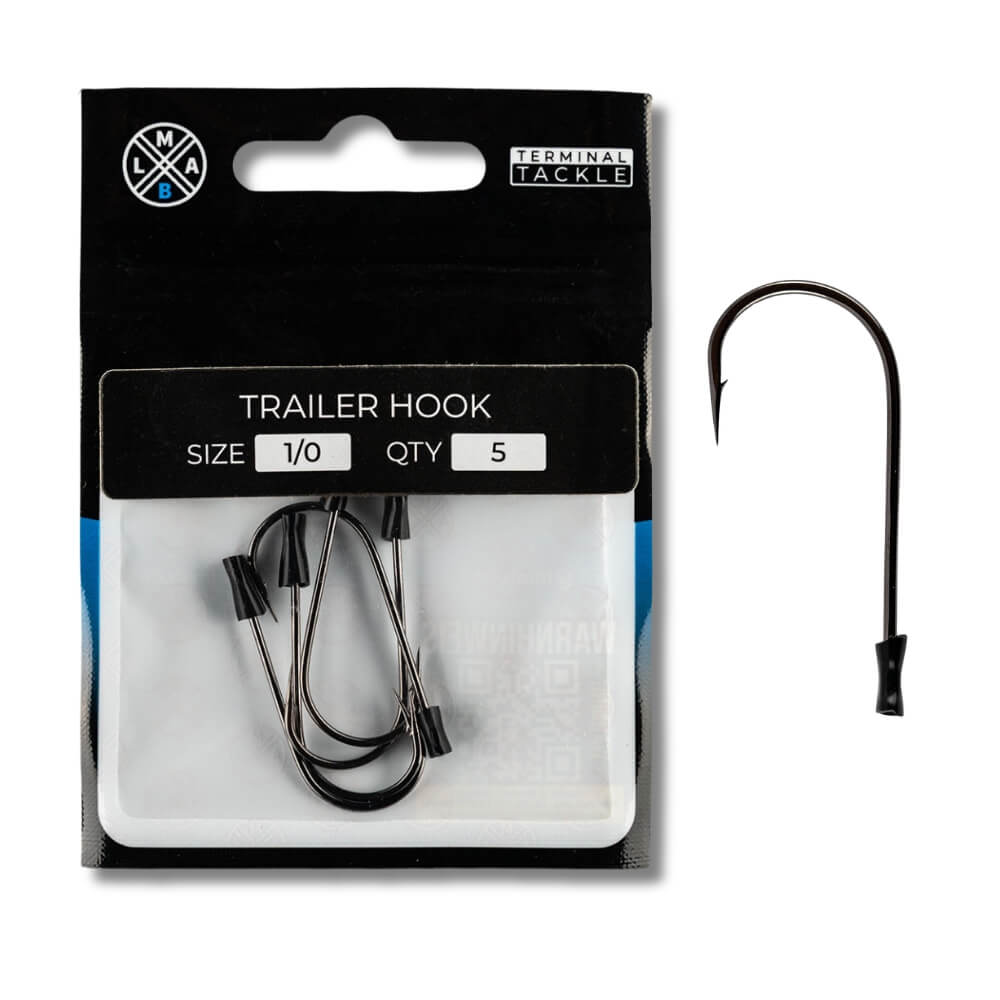
<h2>Information on Trailer Hooks</h2><p>Spinnerbaits are outstanding lures. Few other lures let you work <strong>lily pads and weed beds</strong> so effectively and snag-free, and they are equally capable as <strong>search baits in open water</strong>.</p><p>They do have one drawback, however. Their <strong>weedless design</strong>, with an inward-facing single hook, means the <strong>hook-up ratio</strong> is not particularly high. Missed bites and fish lost shortly after the strike are a common occurrence - and that is where trailer hooks come in.</p><h3>What Is a Trailer Hook?</h3><p>Trailer hooks are single hooks that resemble a classic <strong>Aberdeen worm hook</strong>, though with a noticeably larger eye and heavier wire gauge. The eye is usually fitted with a rubber sleeve, or the hooks are supplied with <strong>rubber tubing, plastic discs or rubber beads</strong>.</p><h3>How to Use Trailer Hooks</h3><p>You simply slip the trailer hook over the single hook of your spinnerbait or chatterbait by its eye. Fixed models with a rubber-covered eye lock firmly in position. Floating models swing freely and are only prevented from sliding off the main hook by a rubber bead. Both styles have their merits. <strong>Freely swinging trailer hooks</strong> tend to connect with fish slightly more consistently, but they also pick up noticeably more weed and increase the risk of snagging. Fixed trailer hooks always stay aligned with the lure and remain relatively weedless. Even so, they improve the hook-up rate considerably and account for the odd <strong>bonus fish</strong>.</p><p>One important point: trailer hooks should be mounted facing the same direction as the main hook - that is, with the hook point towards the spinner blade. Fitting them the other way round increases the <strong>weedless factor</strong> dramatically. When using the spinnerbait as a search bait in open water, orientation matters less.</p><h3>Advantages and Disadvantages of Trailer Hooks</h3><p>On balance, trailer hooks are a straightforward way to improve the <strong>bite-to-land ratio of a spinnerbait</strong> significantly. At the same time, with aggressive fish they can occasionally sit awkwardly and increase the risk of injury to the fish - something worth bearing in mind when you use them.</p><p>They work fine with or without a trailer. When fishing with a trailer, first thread the soft plastic onto the main hook in the usual way, then slide the trailer hook over it. With a trailer fitted, only fixed trailer hooks should be used, as freely swinging models tend to foul themselves in the rubber of the trailer.</p>