





Welcome to this guest article on drop shot fishing for perch in Berlin. We have Felix Ulrich to thank for it — he shares his experiences here and has more than a few useful tips up his sleeve. If you have questions or want to leave feedback, feel free to do so in the comments at the end of the article. Enjoy the read.
Berlin Perch: Why Drop Shotting Delivers
A great deal has already been written about perch fishing in general and the many different methods you can use. So in this article I want to give you some tips on how to fish the drop shot method specifically and successfully for perch in Berlin. You can certainly catch fish on plugs, spinners or jigged lures, but this method has proved particularly effective when targeting the capital's perch.
I live in the south-east of Berlin and will be sharing the experience I've gathered on the banks in that area. The Treptow-Köpenick district alone has 2,062 hectares of water, including lakes, canals and rivers such as the Spree and the Dahme. That accounts for roughly 36% of Berlin's total water surface.
The Drop Shot Rig
What makes this rig special is that the lure is mounted above the weight, allowing it to move almost weightlessly in the water, always slightly above the bottom. The distance between the lure and the weight determines how far off the bottom the lure sits. Bear in mind, though, that the shallower the angle of the line to the bottom, the closer the lure gets to it. This finesse approach is also particularly effective because the fish can take the unweighted lure more easily than when jigging.

Here Ronny had a successful session with his drop shot rig from a float tube.
Tackle for Drop Shotting
You don't need much tackle for drop shotting. A braided main line with a breaking strain of four to six kilos works well. That's enough to handle the odd zander or pike as bycatch. I've had good results with the Daiwa J-Braid X8 and the Sunline PEx8. As a leader I use fluorocarbon in diameters of 0.20–0.30 mm. Getting the balance right with the braid is key here. If you do get a snag, it's better for the fluorocarbon to break than the main line. Add a single hook and a drop shot weight and you have everything you need for the rig.
The fluorocarbon is connected to the main line using an Albright knot. It's relatively straightforward to tie and has a high breaking strain. Another advantage is that it runs smoothly through the rod rings.
I always go for a leader length of two to three metres so I can tie on a new hook easily and still have a decent length of leader left if something does break off. Lines such as the FC1 from Stroft or the Sunline Siglon work very well.
Dietmar Isaiasch explains a modified version of the Albright knot mentioned above, as well as how to attach the hook, in the following video:
Berlin's Challenge: Snags
Unfortunately Berlin has a lot of snags — both natural and man-made — which means you lose a lot of lures when jigging. One clear advantage of drop shotting is its reduced susceptibility to snagging. To reduce it further still, I exclusively use cylindrical drop shot weights. These are even less prone to snagging than round weights. The specialist drop shot weights simply clip onto the line, which lets you quickly vary the distance from the lure to the bottom. A distance of 30 to 50 cm between lure and weight has proved reliable, along with weights of six to twelve grams. I cast my own weights and coat them in black heat-shrink tubing. The black weights are less conspicuous in the water and you get fewer false bites on the weight. I'll go into more detail on that in a separate article.
Rig Basics
-
Braided main line with a breaking strain of four to five kilos
-
Fluorocarbon leader with a breaking strain matched to the main line
-
Single hook in size 2 – 1/0
-
Cylindrical drop shot weights between 5–12 g (black if possible)
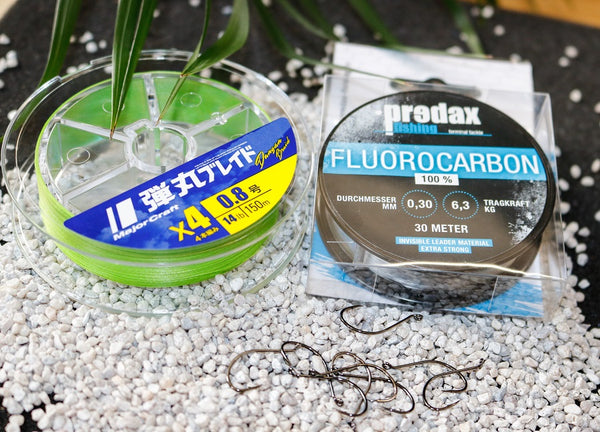
The braided main line and the fluorocarbon leader are matched in breaking strain. Paired with the MUSTAD Drop Shot hooks.
Rod and Reel
For drop shotting for perch, a rod with a casting weight of 4–15 g and a length of 1.80 to 2.40 metres is spot on. If you prefer to fish close in, 1.80 metres and a ten-gram casting weight is enough — if you want to reach further out, 2.40 metres makes more sense.
A slightly stiffer blank with good sensitivity and ideally a SolidTip have worked well for me. Since you're fishing mainly on the bottom, good feedback from the rod helps when exploring the lake bed. You can 'read' the structure and character of your spot with a fair degree of accuracy. Drop shotting also involves animating the lure largely through the rod, which makes a soft rod unsuitable.
A good model for beginners and experienced anglers alike is the Favorite BlueBird at 1.92 metres with a casting weight of 4–12 grams.
A fixed spool reel in size 1000–2500 is perfectly adequate. I run a Shimano Stradic Ci4 1000 on the BlueBird. Make sure the reel suits the rod and that the combo sits balanced in your hand. Not every ultralight rod is best balanced with the lightest reel — but you can test that at your local tackle shop. It makes fishing more enjoyable and is kinder on your joints.
Suitable Tackle
-
Rod with good sensitivity, casting weight up to 15 g and a length of 1.80 to 2.40 metres
-
Fixed spool reel in size 1000 – 2500 (weight chosen to match the rod)

This drop shot rig is a true featherweight: the Fox Rage Drop Shot Fly paired with a light cylindrical weight. If you attach two weights to the end of the drop shot rig, they knock against each other with every movement, creating an additional trigger for the predators underwater.
Hooks
I use hooks in size 2 to 1/0 — the smaller ones for worms and the larger ones for soft lures. They should be very sharp and as fine-wire as possible to ensure a secure hook-hold and a good conversion rate. Also check that the hook gape is relatively wide and that the eye is neatly formed. I trust the VMC 7119 and the Mustad Wide Gap Drop Shot hook.
What to Look for in a Hook:
-
Size 2–1/0, sharp and fine-wire
-
Wide gape and a sturdy eye
Lure Selection for Drop Shotting
One of the joys of drop shotting is that you can use all kinds of soft lures, as well as natural baits such as the classic worm or a baitfish. Other methods simply don't offer that same flexibility. In winter, worms produce some very good fish, while in summer soft lures tend to bring the bigger specimens.
Soft Lures
Anything in the 2–4 inch range works brilliantly. On some days a paddle tail or a crayfish imitation outfishes everything else; on others a pintail or a worm imitation is the one to go with. You'll have to figure that out for yourself — but all of them are well suited to drop shotting.
You can mount the lure on the hook in several different ways. With a nose hook the lure is pierced at the front; hooked wacky style it goes through the middle. Because the weight and the lure are separated, the lure can move more freely than on a jig head. The way you hook it can make the most of that advantage. My personal favourites among soft lures are, without question, the lures from Keitech. The EasyShiner and the SexyImpact are the most productive. The exceptionally soft compound and the scent are irresistible to perch.
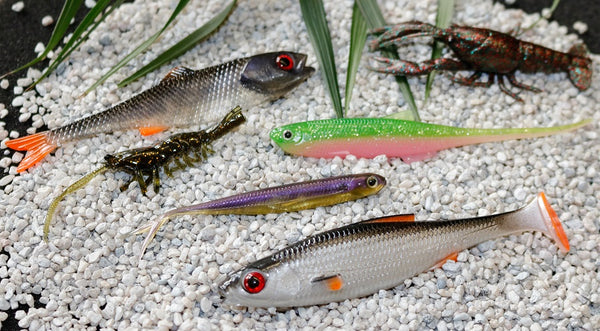
The drop shot rig is versatile: size and shape can be varied at will to suit the water and conditions, and so can the colours.
Lures to Use:
-
Soft lures from 2–4 inch, from active to no-action profiles
-
Natural baits of all kinds
Lure Colours
Green and brown have proved themselves, but the colours from the Barsch-Alarm edition are worth having too — whatever the light or water clarity, there's something in that range for every situation. One colour stands out above the rest: GreenPumpkin/Chartreuse. If I could only pick one colour, that would be it, regardless of sun or water clarity. I don't know why, but something almost always happens on it — even if it's just a small 10 cm Spree perch.
I've caught fish on lures from Reins, fishup and other brands too, but the vast majority of my lure-caught fish have come on Keitech.
Colours You Should Always Have:
-
GreenPumpkin/Chartreuse
-
LimeChartreuse
-
Barsch (BA-Edition)
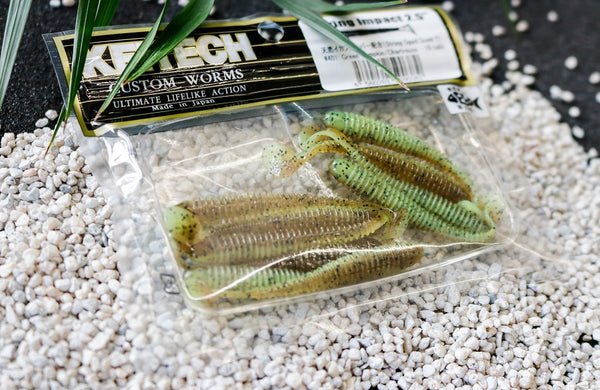
The Keitech Swing Impact in GreenPumpkin/Chartreuse.
Natural Baits
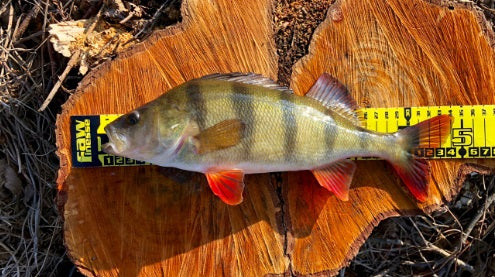
My biggest perch have all come on the classic worm — the dendrobaena. That's how I've landed specimens up to 37 cm, which is a solid size by Berlin standards. On days when the perch are being particularly fussy, a worm can still tempt a fish or two. A lobworm or half of one works just as well. Using deadbait on a drop shot rig is also straightforward. Push the hook up through the head from below and you're ready to go. Cast carefully, as this method isn't the most secure.
Good to know:
From 1 January to 30 April, Berlin has a ban on lures larger than 2 cm. The worm, however, is a natural bait and by no means a poor alternative during that period — provided you can't yet see signs of spawning activity.
Retrieve
One advantage over jigging is that you can present the lure on a single spot for a long time. Once you've found a spot where the perch are holding, you can offer the lure right in front of them rather than just pulling it past, as you would with a plug.
The colder the water, the slower I work the lure. When fishing with a worm in winter I sometimes leave it on the bottom for up to a minute before a bite comes. In summer, on the other hand, working the lure aggressively with lots of small twitches has an almost irresistible effect on the fish.
Things to Bear in Mind:
-
The colder it is, the slower you should work the lure
-
Small, aggressive twitches drive perch wild
Waters
As mentioned at the start, the area around me in south-east Berlin has a vast amount of water. You can choose whether you want to fish under a motorway bridge covered in graffiti (the Britzer Verbindungskanal) or out in nature among beavers and kingfishers (the Seddinsee). Both spots are only half an hour's drive apart, and many of them are easily reached by public transport as well.

The Oder-Spree-Kanal has been my home water for 38 years.
You can catch perch just as well along the busy Spree bank at Treptower Park as on the idyllic Müggelspree near Hessenwinkel. To find out about current water conditions, I recommend the live data from the IGB Berlin monitoring station on the Müggelsee. For a solid overview of current Berlin weather including wind speeds and selected water temperatures, the weather forecast for water sports is well worth bookmarking. To keep an eye on water levels, check PegelOnline.
Fishing Permits Required
In principle you only need two fishing permits to be able to fish the majority of these waters: the DAV Berlin card and the card from the Köpenicker Fischereivereinigung e.V. Both are available from most fishing tackle shops in Berlin.
Good Spots
I fish mainly from the bank, which is very practical given the urban infrastructure — jetties, moorings, sheet-pile walls and so on. That means you can reach a lot of spots on foot. The best perch spots in Berlin are no different from those on any other water. Wherever there's structure, you can be successful — at bridges such as the Schloßbrücke in Köpenick, at ferry terminals like the one in Baumschulenweg, or along sheet-pile walls, for example at the Gosener Kanal.
My tip: don't stay too long at a spot where nothing is biting. The next spot is usually only 50 metres away — but those 50 metres can make all the difference.
Summary
I hope there were a few useful tips in there for you and that you're now keen to try out some of these ideas for yourself. Berlin isn't Hamburg or Amsterdam when it comes to fishing, but you can always enjoy a few good hours of street fishing here — and more often than not, you'll have fish to show for it.
If you have any questions or want to share praise or criticism, just leave it in the comments.