a community report by Tim Schumacher
Fishing large reservoirs is a challenge even for experienced anglers. Coaxing a fish from such a vast expanse of water — and doing so at depths that are rarely explored — can feel overwhelming at first. At the LMAB Möhnesee Weekend, you could see many anglers struggling to adapt to the conditions initially, yet by the end most boats had landed some cracking fish. One method that my brother Jonas and I use successfully throughout almost the entire year, targeting virtually all the predators in the lake, is drop shotting in open water.
What Makes the Möhnesee Special?
With a surface area of over 10 km², the Möhnesee is the largest reservoir in the Sauerland. Depending on the water level, the deepest spots can exceed 30 m, and the lakebed offers relatively little structure. Outside of spring, when fish move shallow after spawning, locating predators at first glance is not straightforward. The key to success is tracking down the lake's number-one prey fish: the vendace (Maränen) shoals. A fish finder is absolutely essential for this. When the vendace are not lethargically hugging the bottom but are scattered throughout the water column — driven upwards by hunting predators — you've found yourself a good spot.

What Tackle Do You Need?
Drop shotting in open water lets you fool a wide variety of predators. Alongside the usual suspects — pike, perch and zander — even large vendace and, this year, substantial eel have been caught on soft lures. You might expect that, given the big pike the Möhnesee is famous for, relatively heavy tackle would be required. In fact, that's not the case.
To detect the delicate bites of vendace and smaller fish, we use relatively light rods with a fine tip in the 10–15 g casting weight range — the sort normally used for perch fishing. That makes a good reel with a finely adjustable drag all the more important. When a big pike takes, it can strip enough line and still be played safely to the net. Because we're fishing in the middle of the lake and the lakebed has virtually no structure, there's no real risk of a running fish wrapping the line around an obstruction and getting away. What does matter is using a line with sufficient breaking strain that runs as quietly as possible through the rod rings.
Lures with a Wire Trace
I personally use an 8-strand braid with a breaking strain of at least 12 kg.
The Rig and the Right Lures
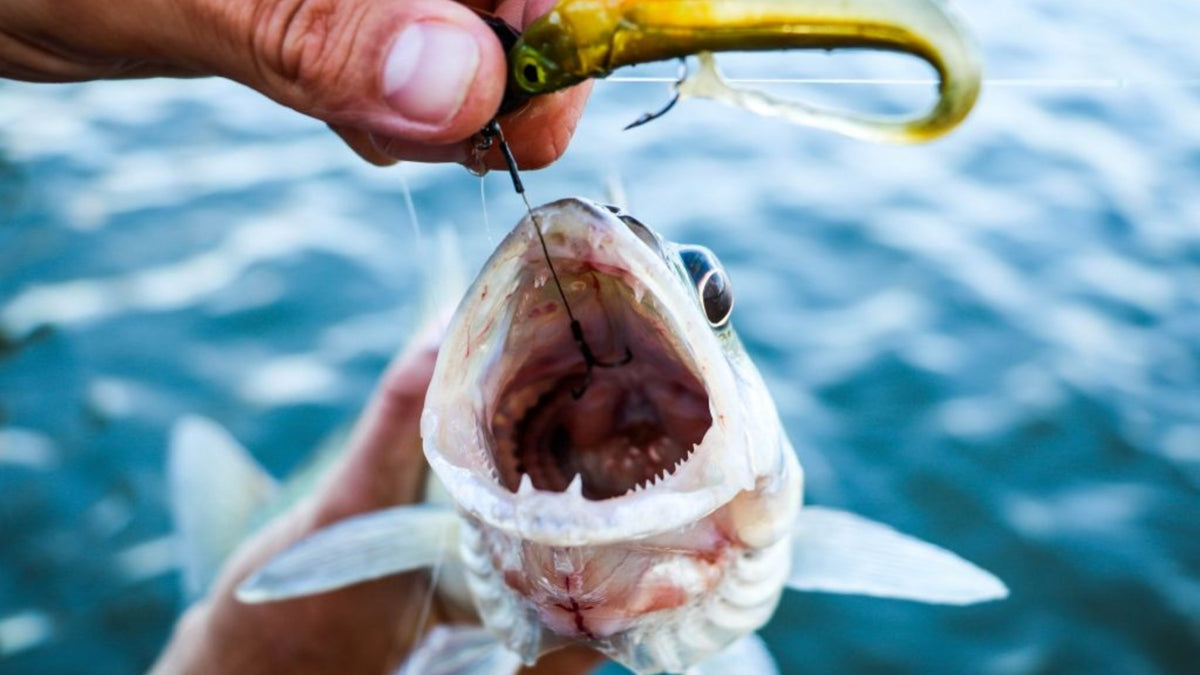
When fishing lures on the Möhnesee, using a wire trace is mandatory. VMC Spinshot hooks offer an elegant way to comply with this rule on a drop shot rig. You run the wire trace only above the lure, making the whole rig pike-proof. A crimp sleeve has the rig assembled in no time, and the wire is less visible to fish that usually attack from below. The distance from the weight to the lure is also set considerably longer than in conventional drop shotting, in order to present the lure as attractively as possible — 1.5 m or more is not excessive here.

The Ideal Lures
I recommend small lures in the 3–4 inch range. If you're specifically targeting pike, you can go a size up. In the clear water of the lake, it pays to use soft plastics in natural colour schemes that mimic the colouring of small vendace. Silver with a blue or black/grey back is always my first choice. A more eye-catching colour in deep water is always worth a try, though. Everything from paddle tails to no-action soft plastics can work well.
This year we've had particularly good results on pintail lures, even during the warmest part of the season. You can thread them onto the hook just as you would on a jig head, but I usually hook them through the head only — nose-hooked.
Top tip:
Occasionally you can pick up a stunned small vendace from the surface — it makes an excellent bait for this method too.

The Method: Pelagic Drop Shotting
What makes pelagic drop shotting so appealing is that you can cover the entire water column beneath the boat with relatively little effort. Normally, with drop shotting, you control the fishing depth by adjusting the distance between the weight and the lure, keeping the lure at a constant depth in the hot zone. With the pelagic approach, however, you lift the weight clear of the lakebed and wind the complete rig slowly upwards. When I say slowly, I mean it. Sometimes the reel handle barely turns — almost in slow motion. I avoid any aggressive jigging or twitching altogether. As long as I can't spot larger fish on the fish finder, I work my lure through the baitfish shoals and wind steadily. As the lure gradually drifts clear of the shoal, it becomes the perfect isolated target for any predator lying in wait — an apparently injured baitfish slowly rising towards the surface. When individual large fish become visible on the screen, it's well worth targeting them directly with the same approach. The tension builds as you watch the fish follow the lure upwards. An attack is often visible on the fish finder before you actually feel it, so stay calm and don't strike too early.

Summary
Pelagic drop shotting with small lures is highly effective on lakes with a good vendace population where you want to fish deeper in the water column. You also have a wide range of potential target species, so there's almost always something willing to bite. The slow presentation is straightforward to master, and you can follow all the action directly beneath the boat on the fish finder.
Fishing permits for the Möhnesee are available at the petrol station in Körbecke and at Angel Ussat on the southern bank of the lake. Uli Beyer's tackle shop is also a great port of call if you're looking to hire a boat for your trip. Permit prices are as follows: day permit 8 euros, 2-day permit 15 euros, weekly permit 25 euros, annual permit 70 euros (plus 10 euros deposit for the catch log, refunded on return by 31 May of the following year).
From next year, permits should also be available online, though further details have yet to be announced. A private fishing boat with an electric motor requires an additional sticker, the cost of which varies depending on the size of the vessel — for a small fishing boat like ours, it comes to just over 70 euros per year.
You can see this method in action in this video:
Tight lines and enjoy your time on the water — Tim
Tim Schumacher wrote this article as a reader contributor for pikeandperch.eu.