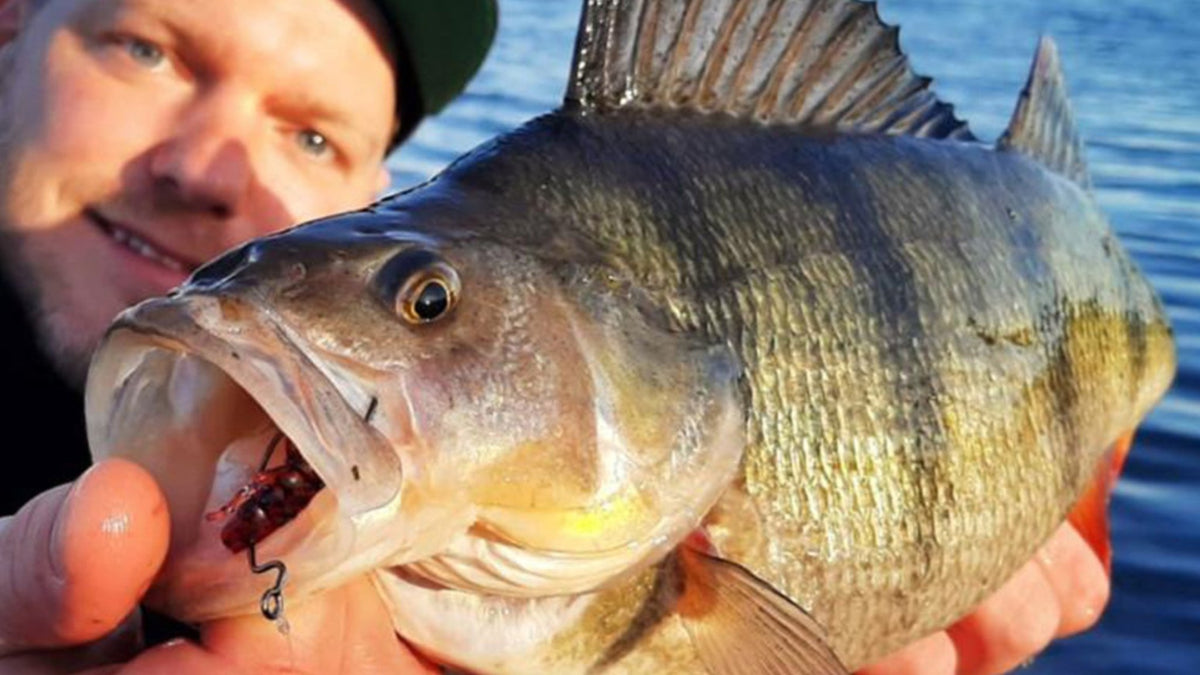
In this blog post, LMAB team angler Gunnar Glimm shares everything you need to know about trout fishing at the start of the season.
Here is an overview of the topics covered in this post:
- Essential tackle for trout
- The right rod, reel and line
- The best trout lures
- Hotspots at the start of the season
- What matters when working your lure
March and April can be genuinely tough months for predator anglers. In most German federal states, the main target species — pike and zander — are under closed season, and in many areas there is a complete ban on lures.
Fortunately, from mid-March, or at the very latest April, there is a more than worthwhile alternative. The trout season opens on streams, rivers and, in some cases, stillwaters — and brown trout and rainbow trout are stunning fish, even if they can be a little temperamental at times. On top of that, your stream may well be heavily coloured from snowmelt or even running high.
To give yourself the best possible start to the season, I am sharing my experience here and showing you what works for me on salmonids in spring.
Trout Tackle for the Start of the Season
You do not need much to go after trout: a short spinning rod, a handful of lures in a small box, a rubber-mesh landing net for handling undersized or oversized fish carefully, and a few bits of terminal tackle. I will walk you through a small selection of tackle that works very well for me and should do the same for you. More is always possible, of course.

Rod, Reel and Line for Trout
When it comes to trout fishing, your rod choice depends largely on the bankside conditions at your salmonid water. In most cases you will encounter plenty of bushes, overhanging branches, roots and trees that can make casting awkward. A rod no longer than two metres is therefore a sensible choice. A semi-parabolic action works well, but a rod with a solid tip is also excellent. On streams I personally like to use the La Moustique by #LMAB at 1.98 m with a casting weight of 2 to 10 g.
If you have more room at your water — perhaps you are fishing a lake and need to cast further — longer options work well too, with a slightly higher casting weight of up to 20 g. Even then, make sure the action is not too stiff, or you will lose too many fish during the fight.
Reel & Line
As a reel, a fixed spool reel in size 1000 to 2000 suits most rod lengths well. A drag of 3 kg is perfectly adequate. Line choice is a matter of debate. I personally fished mono at 0.20 mm diameter for many years because my stream was heavily pressured. That said, you can absolutely fish a thin braid — just opt for a neutral, low-visibility colour. A breaking strain of 5–6 kg is more than enough. You will also want a short fluorocarbon leader of around 50 cm (0.20 mm, for example) and small snaps for quick lure changes.
The Right Trout Lures
Now to the heart of the matter. Trout are true opportunistic feeders and adjust their diet to the time of year.
If you look at a stream in March and early April, you will notice there is virtually no surface food for the trout — quite unlike May and June. At this time of year the salmonids are feeding a layer deeper, picking off insect larvae, small fish such as minnows, fry — even their own — and larger rivals.
As anglers, we need to imitate this spring food spectrum to be successful.
Spinners and Spoons
The classics for trout fishing are undoubtedly spinners and spoons. These lures absolutely must have a place in your box. Models around 4 g are ideal. For colour, take your cue from what the trout are eating.
Silver, gold and bronze with red spots all work consistently. If your stream is coloured from heavy rain or snowmelt, highly visible colours come into their own.
Spinners and spoons are best cast upstream and retrieved with the current. You can also do well casting across towards the far bank and working them with the lateral current pressure.
Soft Lures
The second group of lures I like to use at the start of the season are soft lures and creature baits. Virtually every salmonid water holds smaller fish species, crayfish and other small creatures beneath the surface, and this group of lures imitates them perfectly. They fish particularly well early in the season when, as already mentioned, there is almost no surface food available.
Sizes of 3 to 7 cm are the standard, but right at the start of the season — when the fish have not seen a lure for months — going a little larger is no bad thing. I have personally caught trout of 45 cm on 10 cm shads. Brown trout in particular are highly territorial fish that defend their lie aggressively against rivals, which is why slightly larger shads work well, especially in brown trout colour patterns. Give the KØFI Roach in the Brown Trout colour at 7 cm a try — takes on those patterns are absolutely savage.

For creature baits, small crayfish imitations such as the Finesse Filet Craw in 4 cm are a good shout, and dragonfly larva imitations also work very well on streams. Shads can simply be retrieved steadily; depending on water depth, jig heads of 7 g may be necessary. Work creature baits with the current or parallel to it, hopping them along the bottom in small jumps or simply dragging them. The key point is to get the lures down to depth — that is where the trout are feeding right now.
Hard Lures
Hard lures also fish very well at the start of the season. Crankbaits and twitchbaits are the best options; the same rule of thumb applies here — sizes between 3 and 7 cm, though larger lures catch too. I personally love twitching for brown trout and have no hesitation using baits around 9 cm. A 35 cm brown trout has absolutely no issue with those, especially in spring. The most important thing is to fish with the current or across it. With crankbaits, also pay attention to a stable action — plugs that spin on their axis at higher retrieve speeds tend to spook fish rather than attract them.

If none of these lures are producing, you are facing a genuinely tough water. But there is one joker that has saved my day more than once: try a streamer on a finesse rig (such as a Carolina rig). On stillwaters in particular this is a real weapon when the trout are still holding very deep early in the season. The rig can be worked aggressively or incredibly slowly, depending on what you need at the time.
Hotspots at the Start of the Season
Before I go into a few specific hotspots on streams, rivers and lakes, here are some general tips to start with:
It always pays to fish a stream or river upstream — move against the current, cast your lure in that direction and retrieve it back towards you with the flow. Most trout lie facing upstream, so this way they will not spot you until much later.
Waders are not essential, but always useful. Before you wade in, though, make sure wading is actually permitted at your water — some venues only allow you to cross, specifically to protect salmonid spawning grounds.
The clearer the water, the more you need to stalk.
Fortunately, at the start of the season we still tend to have slightly coloured water, which at least makes it harder for the fish to pick out your silhouette.
So where should you start your search for that opening fish of the season?
Generally speaking, trout in spring are found in similar spots to later in the year. In still-cold water, though, they favour the slightly slower-flowing and deeper sections of a stream. That makes sense — it is precisely here that aquatic life is beginning to regenerate, and where the fish find most of their food right now.
Scoured outer bends are a year-round hotspot. These fish particularly well with soft lures and plugs, which you can swing around the current seam in a single cast and present right in the productive zone.
On the first warm spring days you will often find the trout on sandy, shallow spots too. These areas warm up faster when the sun is out, drawing fish and their prey in like a magnet.
The Special Case: Stillwaters
In many regions of Germany, trout have been stocked into stillwaters and provide a great option when streams are unfishable — due to flooding, for example. At this time of year they hold mainly in the deeper areas and become active when the sun warms the shallows, drawing them in to feed.
In the deeper sections, crankbaits and soft lures on heavier jig heads are your best bet. A drop shot or Carolina rig is also well worth trying. In the shallower areas, twitchbaits and metal lures excel.
Some stillwaters — such as those in the Oberharz region — even hold migratory trout: fish that spend most of the year in the lake or pond before dropping into small feeder streams to spawn in winter, much like sea trout do. Those very feeder stream inlets are of course prime spots in spring, provided fishing is permitted there.
Conclusion
I hope these tips help you kick off the season in style!
Any questions? Drop them in the comments or send me a message on Instagram.
Petri and Tight Lines, Gunnar (@glimmi_lmab)