What Is the Kickback Rig?
To tie a Kickback Rig, you really only need a length of fluorocarbon, an offset hook or an eye hook, and a weight. Start by tying a piece of fluorocarbon roughly 1 m long to your main braid — a Double Grinner or a Mahin knot works well here.

You don't need much tackle to set up a Kickback Rig.
Materials for the Kickback Rig:- Offset hook or eye hook
- Fluorocarbon
- Weight
 The Mahin knot is one of my favourites — it slides through any rod tip ring without snagging. I personally prefer slightly heavier fluorocarbon at 0.39 mm diameter, especially when I'm fishing stony venues with a high chance of mussels on the bottom. If you're expecting smaller fish and clean ground, you can go lighter. At the end of the leader, tie on a single hook using an Improved Grinner knot. You can use a plain eye hook or an offset hook — whichever suits the size of your lure. Then, about 30 cm above the hook, tie a dropper arm into the leader.
Short or Long Distance on the Dropper Arm?
Anglers like Herbert Ziereis prefer a noticeably longer distance. As a general rule, though, a greater distance leads to poorer bite detection. For the dropper arm, take a generous length of fluorocarbon and tie it firmly onto the leader using a dropper knot. The weight is then attached to the end of the dropper arm. The arm should be roughly 5–15 cm long and, when folded alongside the leader, must not reach as far as the hook or lure. Bear this in mind when tying — cut a slightly longer piece so you can tie the dropper comfortably. You can always trim it afterwards.  This is what the Kickback Rig looks like at the water.
Choosing Your Weight
A wide range of weights suit this rig. If you want to fish it ultra-light, you can simply pinch a split shot onto the dropper arm. Otherwise, a standard pear-shaped weight or a drop shot weight works just as well. I personally tend to snap the lead heads off bent or blunt jig heads and reuse them. Recycling old jig heads is a great alternative for a Kickback weight.
Advantages of the Kickback Rig
The Kickback Rig offers quite a few advantages over other rigs. Let's start with the weight. It serves as casting weight and, when you're fishing close to the bottom, it kicks up silt and debris near your lure, which attracts attention. Fair enough — other rigs do something similar. But what sets the Kickback Rig apart is that the weight's actual mass is almost irrelevant. Apart from the sink phase, it has virtually no effect on the lure's action. That means you can fish with weights of 50 or 60 g in places where standard jig heads simply wouldn't reach bottom. In summer especially, zander often hold right in the main current of a river — and that's exactly where the Kickback Rig with a heavy weight comes into its own. You can also achieve much longer casts and reach spots that would otherwise stay out of range. I'm also keen to try the rig when targeting cod in Norway one day. In summary:- Unique lure action
- No resistance for the fish when taking the lure
- Few complete losses, quick to tie
- Minimal tackle required, extreme casting distances possible
- Can be fished with heavy weights without affecting the lure's action
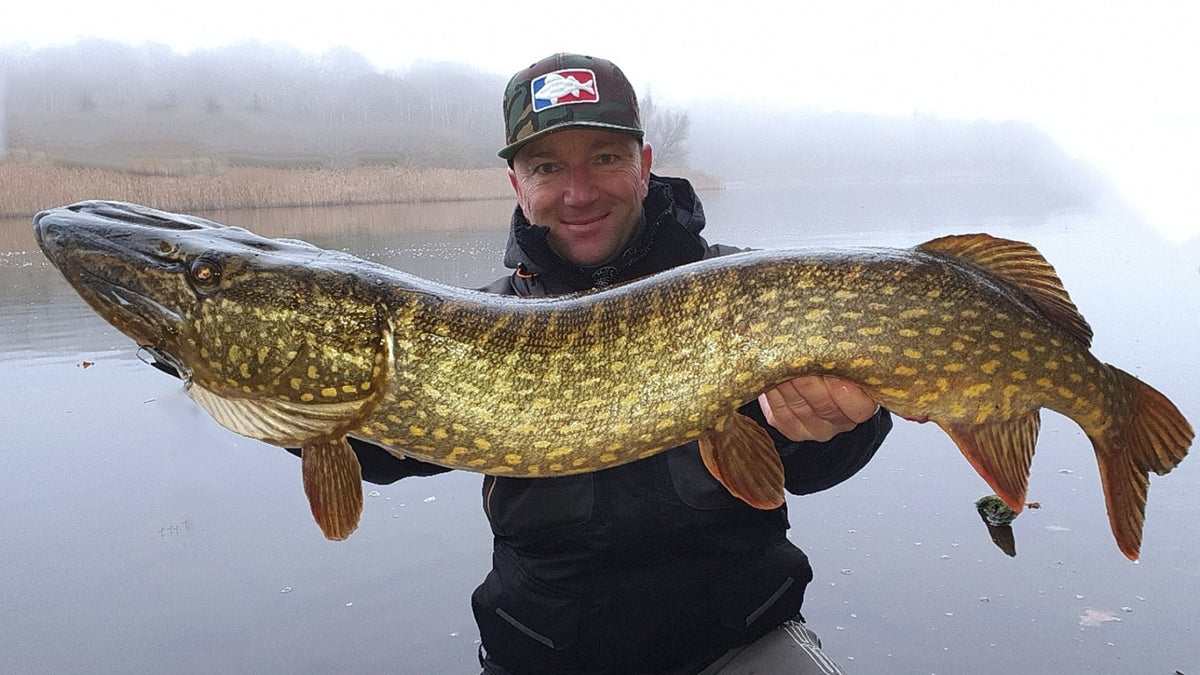
 This zander took the Kickback Rig far out in a harbour basin.
Another advantage — shared by the Carolina rig and the drop shot rig with a dropper arm — is that the lure behind the weight is virtually weightless, allowing fish to take it easily and without resistance. On top of that, if you do snag up or snap off, you don't usually lose the whole rig.  In this case, a drop shot weight is attached to the end of the dropper arm, which I've also secured with a simple overhand knot.
Choosing the Right Lure
To get the most out of the Kickback effect, you want to use buoyant soft lures. The lure sinks to the bottom with the weight, then slowly kicks back up and rises. For a buoyant lure to actually float up properly, use the thinnest wire hooks you can. For lures like the Finesse Filet Craw, I like to use thin offset hooks. For air-filled lures, you can carefully thread a single hook through the nose of the lure. It's worth checking the buoyancy of your lure at home in a bowl of water, or on the bank before you start fishing. Sinking lures will also work — you just lose the Kickback effect. It still catches fish, though! When it comes to lure choice, you can use almost anything that normally works at the venue — from creature baits and tubes to standard soft lures. Personally, I fish most often with crab-style lures or fringe tubes.
Suitable lures for the Kickback Rig:
- Crab-style lures
- Creature baits
- Tubes
- No-action and action shads (to preserve the Kickback effect, go for floating or strongly buoyant models)
 To avoid piercing the air chamber, these lures are best mounted carefully on an eye hook.
Working the Kickback Rig
How to retrieve the rig is, like the 'correct' distance between hook and dropper arm, a topic anglers don't always agree on. Some keep the rig in constant contact with the bottom — either dragging it or slow-rolling it along. Personally, I also throw in the odd hop now and then, particularly in summer.As a general rule, pause after each turn of the reel handle before winding on.
That pause is usually when the bite comes. How clearly you feel it depends on the distance to the dropper arm. With my relatively short distance, you get a sharp, distinct knock from both perch and zander.
Summary:
- Constant bottom contact (dragging or slow-rolling); in summer, you can mix in a few hops.
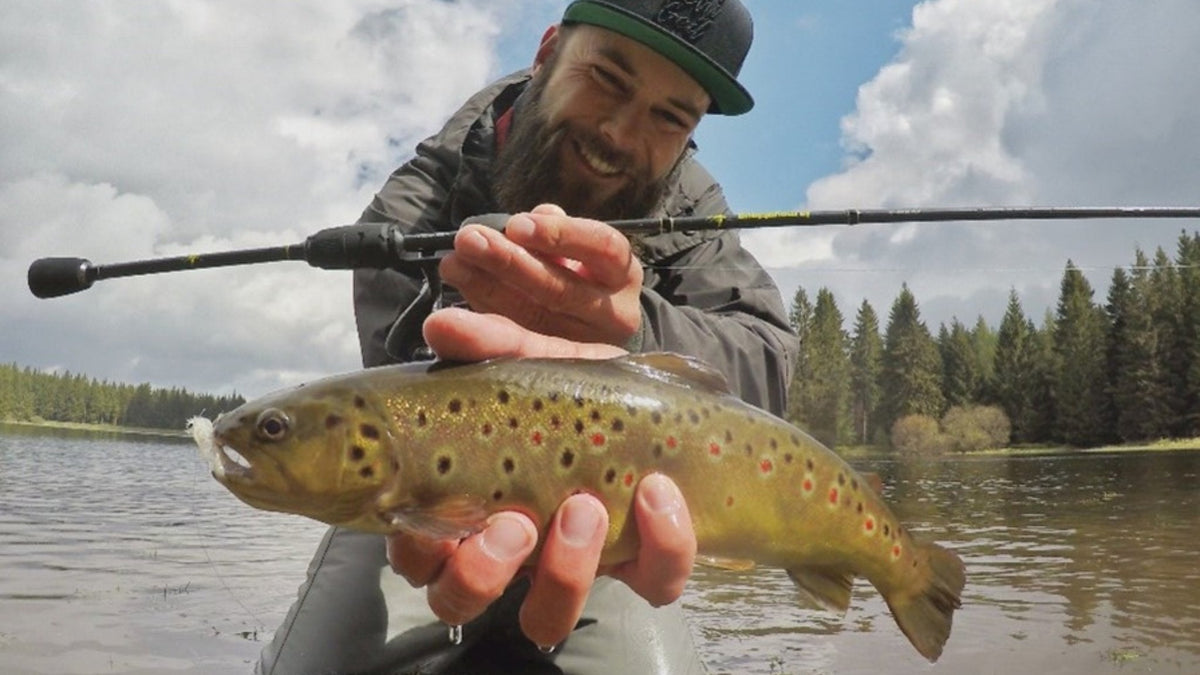
 The bite from this perch was clearly felt thanks to the short dropper distance.
With a longer dropper arm — which works well in winter, for example — fish can sometimes feel as though they simply 'hang' on the hook rather than giving a sharp knock. Unlike drop shotting, I use slightly stiffer, heavier rods for the Kickback Rig. This lets me handle heavier weights and gives me bite detection similar to jigging. One rod I'd recommend for this is the #LMAB La Moustique Spinning at 2.25 m with a casting weight of 7–21 g. At the end of the day, it doesn't really matter how strong the bite is — because you will catch fish on this rig.
Good luck and tight lines, Dennis (@stramme_leine_siever)