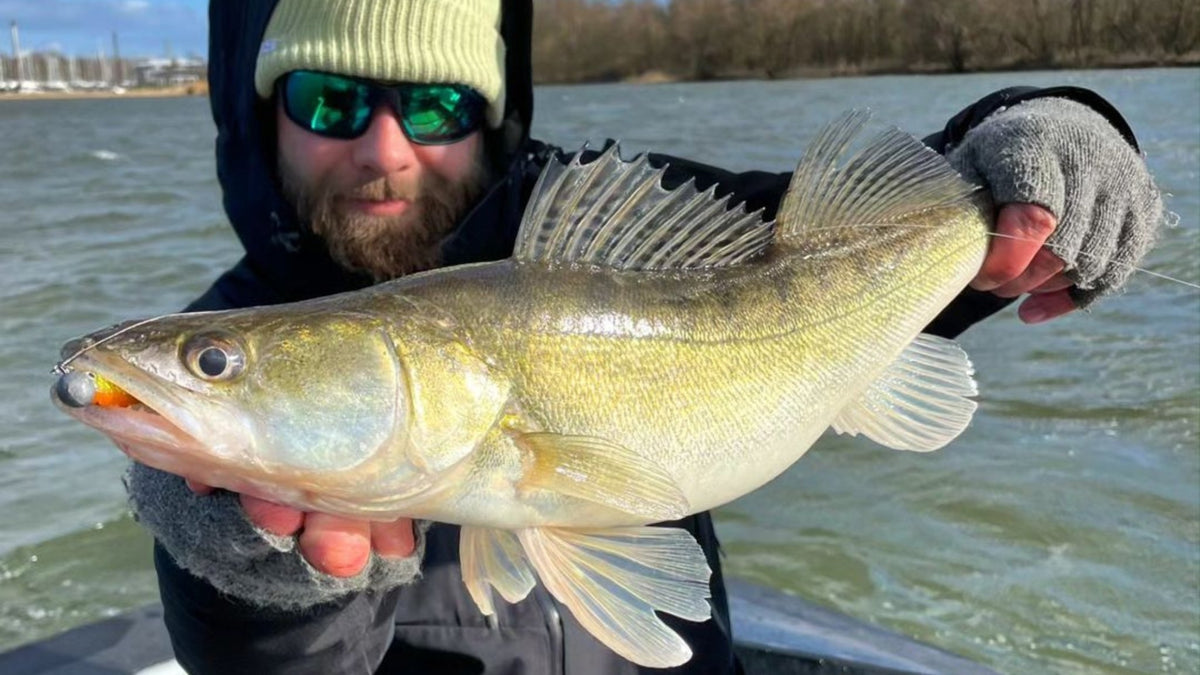
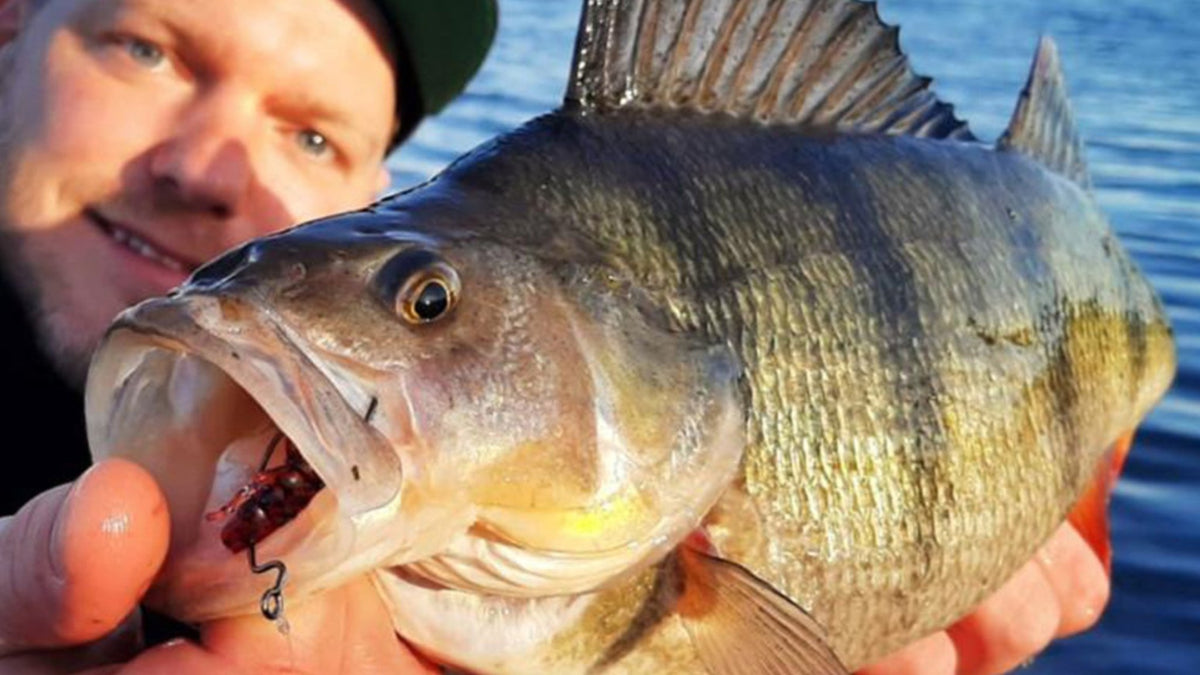
Every year in May, the time comes round again. The pike have spawned and a new pike season begins. The exact start date varies slightly depending on the federal state, so make sure you check when you're allowed to target Esox in your area before heading out. A useful overview of all closed seasons can be found here: Angelmagazin.
In Mecklenburg-Vorpommern, fishing resumes from 1 May. The waters of the Müritzfischer are an exception, however — there is no closed season there. Protection of spawning fish is managed through a retention window of at least 60 cm and no more than 90 cm.
In this article I'll be focusing in particular on bank fishing for pike, because this style of fishing is exceptionally productive right after the closed season. You'll find out about the tackle, the lures, the zones to target and the key spots — everything you need to get your pike season off to a flying start.

A fine pike taken on a Køfi Perch from Glimmi
Tackle: What Do You Need at the Start of the Season?
Rod
For bank fishing at the start of the pike season, use spinning rods around 2.4–2.7 metres in length with a casting weight of around 30–100 g. Pike rods should have a progressive, fast action. This loads them better during the cast and absorbs the head shakes and explosive runs of the fish more effectively. Rods that are too soft aren't suitable, as they often fail to transmit the strike cleanly.
Reel
A size 4000 fixed spool reel is the right tool for the job. Smaller fixed spool reels aren't suited to dedicated pike fishing. Because you're using larger and heavier lures, you need a more robust reel. The larger spool diameter allows longer casts and holds enough heavy line. Size 4000 reels also deliver solid drag performance — around seven kilograms of drag is a reasonable benchmark. Round off the combo with an 8-strand braid with a breaking strain of around 18 kilograms.
Lures
For lures over 100 grams, a baitcasting rod paired with a baitcaster is clearly the better choice. Casting with this kind of combo takes a little more practice, but heavy lures can be placed far more precisely and comfortably.
Leader
I use hard mono with a diameter of at least 0.9 mm as my leader. Many anglers also use wire traces or titanium leaders. I use titanium when perch fishing in water where pike are likely and the leader needs to be very thin. Pike have a great many small, very sharp teeth, which will cut through a leader that's too thin without any trouble. I've only ever had good results with hard mono and haven't lost a fish to a break-off yet.
Landing Net
Your landing net should be large enough, rubber-meshed and ideally fitted with a telescopic handle so you can land fish safely. Waders are also a real advantage when bank fishing. They let you wade further out and reach key spots — such as reed beds — that you simply can't cast to from dry land.

Hotspots: Where to Find Pike in Spring
Finding pike is actually not that difficult.
Like all predators, pike stay close to smaller fish — their prey.
In spring, pike move into the margins to spawn. After spawning, they remain in the shallows to recover and feed. The water warms up faster there, and as the light increases, aquatic plants begin to grow again — perfect conditions for baitfish to shelter in. You'll find pike wherever the baitfish are. That's why the margins are a prime spot right after the closed season.
Pike love structure. Reed beds, lily pad fields, fallen trees and shallow flats are all ideal places to target your first pike of the season. Keep an eye out for surface activity. When roach and other non-predatory species are spawning and splashing along the reed edges, that activity draws pike in fast.
A good pair of polarised sunglasses can make a real difference here. Have a look at the Sclera from LMAB — they let you spot pike on the hunt and cast directly to them. They also float, which is a handy bonus when you're wading.
Once you've caught a pike from a spot, keep working that same area. After spawning, several fish often hold close together.
Keep Open Water in Mind
If the shallows aren't producing, you can always search the mid-water or deeper layers. The pike may already have moved out into open water.
Water circulation in a lake is largely driven by the wind, which also influences water temperature and the distribution of food for smaller fish. A useful rule of thumb:
Food for baitfish — and the predators that follow them — accumulates on the windward bank.
I've found this rule of thumb to be reliable without exception. One thing is also clear: as air temperatures rise and the water warms with them, pike get hungrier. Pike are cold-blooded animals, which means their body temperature — and their metabolism — is directly linked to water temperature. The warmer the water gets, the more hungry the pike become, which is good news for the angler.
Use a Float Tube
My tip if you're drawing a complete blank: try a float tube. It opens up spots that are impossible or very difficult to reach from the bank. You will need a bit more kit, though, and you'll need to find a water where fishing from a float tube is permitted.
Lures: Tempting Spring Pike
After spawning in spring, pike spend some time in shallow bays or along the margins near reed beds, rebuilding their energy reserves. For that reason, I favour shallow-running lures straight after the spawning period.

Jerkbaits
Jerkbaits up to 15 cm are my first choice at this time. You can work them in a variety of ways — a steady retrieve with pauses at different speeds, or short twitches of the rod. When varying your retrieve speed, a reel with a high gear ratio helps, letting you vary the pace even further and bring more life to the jerk.
Soft Lures
Soft lures also earn their place at the start of the season. I like to go with medium-sized options such as the #LMAB Köfi in 14 and 18 cm or the #LMAB Drunkbait in 16 cm.
Their large paddle tails generate serious underwater pressure and trigger those hungry pike.
Plugs
Plugs are also excellent for searching different depth zones. There's a wide variety to choose from — crankbaits, twitchbaits, glide baits and swimbaits all have their place.
The size and angle of the diving lip determine how deep each plug runs. You can also choose between sinking, floating and suspending models depending on the material and construction. All plugs work well for pike.
Spinners
Spinners and spinnerbaits produce strong pressure waves underwater that really get aggressive pike fired up. Those pulses make it easy for predators to home in on the lure. The rotating spinner blades keep the lure moving in a steady, relatively slow arc through the water, giving pike plenty of time to close in and strike. My biggest pike to date came on a spinnerbait — give it a go.
Which Colours for Pike Lures in Spring?
Don't be afraid to go bold with your colours, as pike are especially aggressive after spawning. Pike-pattern colours also produce well at this time of year — and for good reason, because pike are actively chasing off rivals and competitors right now.
Tactics: How to Get to the Predators
Start your first casts close to the bank. If you cast straight out to full distance and hook a pike, you risk spooking any fish still holding in the margins. After spawning, pike are hungry, but they're not yet as fast as they'll be in summer or autumn. Work your lures with variety and don't retrieve too quickly. I'll alternate between a slow retrieve with pauses, a slightly faster pace, then another brief stop. Bites often come during that short pause.
Most jerkbaits run quite shallow, so they can be worked just below the surface in the margins. The slow, zigzag action of jerkbaits really provokes pike, and the take is usually aggressive.
Lightly weighted soft lures are also very effective here. I go with jig heads around five grams, which lets you present the lure very slowly and at a shallow depth.
To cover the margin zone thoroughly, I also like to use shallow-running plugs. Suspending models work best — when you pause the retrieve, the lure holds in place and the pike can take it without any effort.
Once you've worked the bank with a few casts, it's worth pulling on your waders and stepping further into the water. Move as quietly and smoothly as you can.
To search the next layer down, I switch to soft lures on heavier jig heads (10–15 g). Let the lure sink and then jig it through the relevant depth zone.
If none of these approaches produce, try changing the size, colour or profile of your soft lures. Big pike in particular can be very cautious biters.
Summary
Whatever you're doing out there, always err on the side of fishing shallower rather than too deep. If your lure is below the pike, it's very hard for the fish to detect it. Fish above the pike and it can see the lure clearly — and attack.