





Introduction: The Basics of Big Rivers and Zander
Hi everyone! My name is Eugénio, I'm 28 years old and have been fishing since I was four. I'm lucky enough to live in Krefeld, right on the banks of Germany's second-largest river – the Rhine. At 1,232.7 km long, the Rhine is one of the busiest waterways in the world.
Zander in the Rhine
Zander thrive in waters like this, which is why the Rhine holds an outstanding zander population. That said, its sheer size makes it a challenging place to fish. When I started out, I struggled enormously to get to grips with this water. I spent countless hours on the Rhine without ever seeing a single zander. I know exactly how daunting a big river can be, so I'd like to make your introduction to this type of water a little easier.
Zander: Light-Shy and Nocturnal
The key thing you need to know about our target species is that zander are extremely light-shy, nocturnal predators. During the day, you'll find them mainly in coloured, murky sections of the river. You can catch zander throughout the day, but your chances improve dramatically if you target them at dawn, dusk, or even in complete darkness.
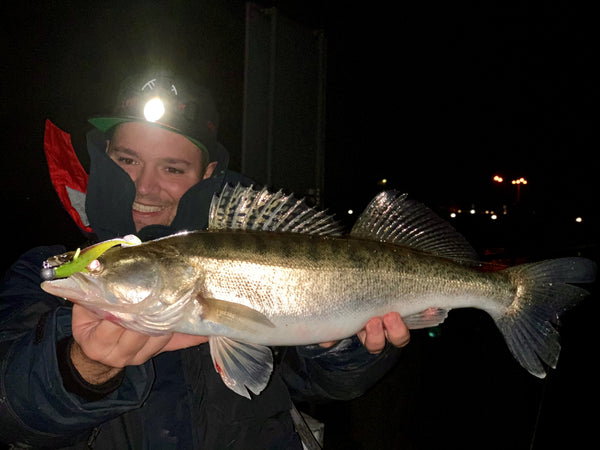
Zander on a soft lure – a proven producer: #LMAB KØFI Perch 11cm Green Pumpkin Chartreuse
How to Find Zander:
- During the day, look for coloured, turbid sections of water
- Fish at night or during the twilight hours
What You Need to Know Before You Start
To fish legally on German rivers, you'll need a valid German fishing licence (Fischereischein). Contact your local authority to find out when and where you can sit the exam. You can prepare with either an in-person course or an online course. If you already hold a licence, all you need is the relevant fishing permit for the water.
Fishing Permits (Gewässerkarte)
Permits are tied to a specific water or federal state – you'll need the one that covers the water you want to fish. You can pick up a Gewässerkarte from many local tackle shops or from online providers such as Hejfish. This year in North Rhine-Westphalia the annual fee is €40, which covers the entire Rhine within NRW. Make sure you check the no-fishing zones and, crucially, the closed seasons – both are printed on the permit itself.
In NRW, zander have a closed season from 1 April to 31 May.
It's vital that zander are left undisturbed during spawning. In years with a cold spring, it's worth waiting a little longer even after the official closed season ends.
Privately Leased Stretches
On some large German rivers, certain stretches are leased by clubs, associations, or private individuals. On these sections you may need an additional permit, or you may not be allowed to fish there at all. Always do your research before heading out.
Zander Fishing in the Netherlands
If you want to fish for zander in the Netherlands, you can pick up a VISpas online or at a local shop. It covers roughly 90% of all Dutch waters and requires no additional exam. The cost is around €50.
Summary
Fishing for Zander Legally:
- When fishing in Germany, a valid Fischereischein is mandatory (some federal states issue tourist licences)
- In many cases you'll also need to purchase a Gewässerkarte for the specific water, stretch, or region
- In the Netherlands, the VISpas gives you access to a huge range of waters without the need for an additional exam
Finding and Fishing Your Spots
The single most useful tool for scouting good spots is Google Maps. Switch to satellite view, browse the river from your sofa, identify interesting-looking areas and mark them with a label.
Here's an example of this approach:
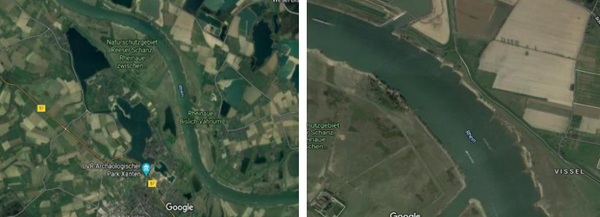
Google Maps satellite view of the Rhine, zoomed in on the outer bend
Boating App
Another handy tool is the Boating App by Navionics. It lets you view depth charts and identify interesting areas using depth contours. Going into full detail would take up too much space here, but it's well worth a mention. One rule, though, applies everywhere:
Never fish spots deeper than ten metres.
Most zander struggle to equalise the pressure change and don't survive after the fight. The depths where you'll typically find zander range from two to nine metres – more on that later.
Watch the Water Level
Here's another useful tip: the higher the Rhine's water level, the greater your chances of landing a genuinely big zander.
You can check water levels across Germany here: ELWIS
Zander Hotspots on Big Rivers
A Quick Overview of the Best Spots on Big Rivers Like the Rhine, Elbe and IJssel:
- Lake entrances
- Harbour entrances
- Ferry terminals
- Lakes connected to the river (note: in Germany these usually require a separate permit)
- Harbours and turning basins (note: in Germany these usually require a separate permit)
- Oxbow lakes and canals that flow into the river (note: a separate permit is usually required)
- Probably the trickiest spot, but also one of the most productive: groynes – especially those on outer bends
How to Approach Groyne Fishing
Where exactly do you position yourself at a groyne, and which areas within it are worth targeting? For less experienced anglers, it makes sense to cast with the current and fish against it. The same applies when fishing entrances and similar features. Casting with the current makes fishing within the groyne much easier, as the flow pushes against you rather than dragging your jig head back towards you.
I put together a quick bird's-eye sketch to illustrate what I mean:
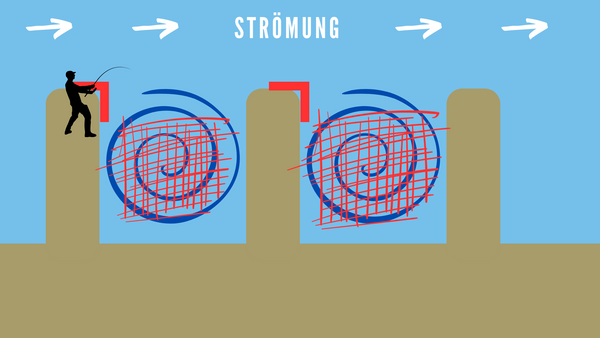
The sandy-coloured area represents the groynes, the light blue the water, and the arrows show the direction of flow
The diagram shows the flow pattern as it enters the groyne. A reverse current forms inside the groyne pocket – you can actually watch this on the water's surface. That reverse eddy is a prime spot, because zander love to hold there and wait for small baitfish to get swept in by the current.
Another great area is the current seam itself, where slack water meets the main flow. You can work this edge again and again.
I've tried to highlight the spots you should never skip when groyne fishing using the red-pixelled areas in the diagram.
That said, you can never say exactly where zander will be holding – in summer they'll happily sit in knee-deep water.
That's why it's worth working the entire groyne thoroughly. I pick a point on the horizon as a reference, use it to orient myself, and fish the area in a fan pattern.
Zander Fishing After Dark
Once darkness falls, the feeding really kicks off. Zander start hunting actively and move into the shallows. You can work them along the rip-rap with shallow-running plugs. That said, don't neglect your soft lures – you can still fish the inside of the groyne and the current seam just as effectively.
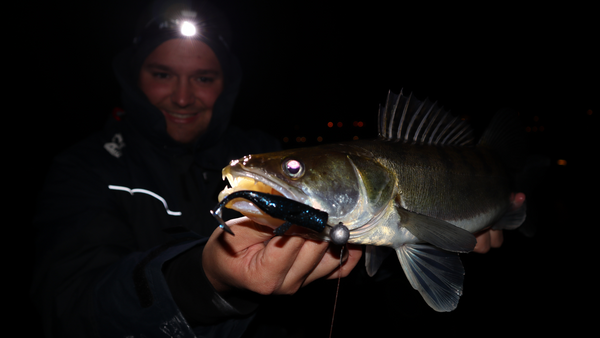
Zander in the dark. One of the most underrated colours at night: black. Lure: #LMAB Drunk Bait 8 cm NightSky
Summary
Where to Find Zander:
- Target spots where the river's structure changes or is interrupted
- Look for current seams and reverse eddies
- Work productive-looking areas thoroughly
- After dark, try shallow-running plugs along the rip-rap and fish higher in the water column
Essential Tackle: What Do You Need?
The single most important aspect of tackle for bank fishing on a big river is safety. Never underestimate the forces of nature. These are often extremely powerful rivers that have, sadly, already claimed lives. Always wear sturdy, non-slip footwear and never risk your life for the sake of a fish. I'd also strongly recommend keeping your phone in a waterproof zip-lock bag so you can call for help in a genuine emergency.
Now that we've covered the most important point, let's go through the essential tackle step by step.
The Right Rod for Bank Fishing for Zander on Big Rivers
Rod choice is an extremely personal subject – anglers rarely agree on this one. From my own experience, an extra-fast rod with a sensitive tip and plenty of backbone is the ideal zander rod. I prefer a length of 240 to 270 cm and a casting weight of around 15 to 60 g.
As a general rule, the better the quality of the rod, the better the feedback – and the more enjoyable it is to fish. It should also be specifically designed for bottom techniques. Feel free to ring the team in Berlin for advice, or head to your nearest tackle shop and try a few rods out. I've personally fished a number of models I'd happily recommend:
- Fox Rage Terminator Spin Jigger X
- Solution Contact by BigL 270 / 10-45
The Bullseye Jig Whip 2.0 is another rod that's hugely popular among zander anglers. By all accounts it's excellent – I haven't personally tested it yet, but it's firmly on my list.
The Right Reel for Bank Fishing for Zander
Go for a fixed spool reel in size 3000 or 4000. The same rule applies here: the better the quality, the smoother and more enjoyable it is to use.
Your reel is your workhorse.
It takes the most punishment of anything in your setup – casting, retrieving and playing fish. Only you can decide what you're willing to spend, but durability matters. Would you rather buy a new reel every season, or invest in something that gives you years of pleasure?
Be prepared to spend at least €50 to €60 on a zander reel – there's no upper limit. Some reels cost close to €1,000. For me personally, the Shimano Stradic Ci4+ hit a superb sweet spot between performance and value. Its successor, the Shimano Vanford, is said to be even better for smoothness and longevity – also on my list ;-)
Other manufacturers such as Daiwa and Abu Garcia also offer high-quality, long-lasting options well worth considering.
The Right Line for Bank Fishing for Zander on Big Rivers
This is one of those topics that sparks endless debate. You should definitely use an 8-strand braid – ideally one that's quiet, thin and yet carries a high breaking strain. There are countless brands, colours and specifications out there, so you'll need to try a few and find what works best for you. It's a subject that gets people genuinely passionate.
Don't focus on line diameter – focus on breaking strain.
Aim for a line with around 10 kg breaking strain. Over the years I've tried plenty of options, and right now I'm extremely happy with the Sunline Siglon PE X8 (orange, 16 lb). The Sunline Super PE 8Braid is also an absolute top contender.
The Right Lures for Bank Fishing for Zander on Big Rivers
Zander feed mainly on smaller fish – things like gobies, perch, smelt, bleak and rudd. Prey fish size is typically around five to 16 cm. The most commonly used soft lures fall in the eight to 14 cm range, though if I had to pick a single universal size it would be 12 cm.
In winter you can fish slightly larger, while spring and summer call for something smaller. Zander feed less in winter but tend to go for bigger prey, whereas in summer they chase small fry. That's a rough guideline rather than a hard rule.
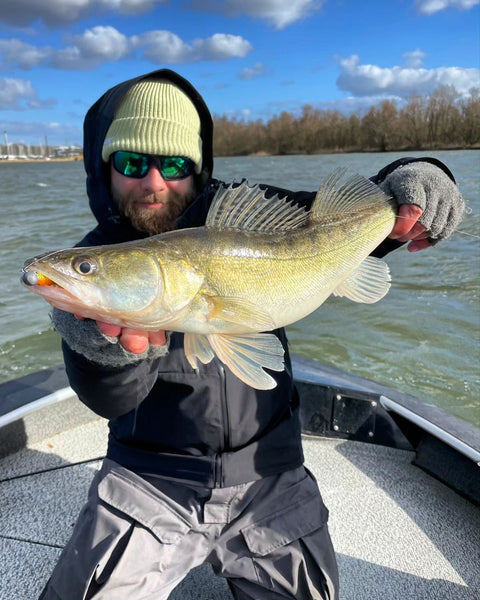
Soft Lure Shapes
You have V-tails, shads, pintails and curly tail grubs to choose from. Each shape and tail design gives the lure its own distinct action. I always carry a variety on the water to see what works on a given day, but if you're just starting out, shads are a great place to begin.
Focus more on your lure presentation than on the lure itself. I'm firmly convinced that flavoured soft plastics catch more fish as a rule. If yours aren't scented, you can add attraction with a product like Illex Nitro Booster. I also always look for a soft, supple rubber mix – zander can fold and inhale these much more easily when they bite.
Lure Colours for Zander
Match your colours to the conditions. In overcast weather with heavily coloured water, go for something UV-active. In bright sunshine with clear water, natural-looking lures often work better. In my experience, on many rivers you'll do very well with perch-style patterns, Green Pumpkin Chartreuse, white-fish imitations and green lures. After dark, try black soft lures or very shallow-running plugs with minimal action.
Other Useful Gear for Bank Fishing for Zander on Big Rivers
You should always carry a landing net (rubberised mesh is ideal), a measuring board and a knife. You'll also need leader material and the right jig heads. For your leader, use fluorocarbon of around 0.35 mm – a metre-long trace tied directly to your main line works well. The material from Predax and Stroft are both reliable choices. You'll also need snaps for quick lure changes – these are often the weak point in a predator rig, so always go for quality. I can wholeheartedly recommend the brands Predax, Profiblinker, BKK and Spro.
For jig heads, sizes 3/0 to 4/0 are what you need (depending on the manufacturer), with weights from 7 g to 28 g depending on current pressure and the spot you're fishing.
Fishing Techniques: What Really Matters?
As a rule, zander hold close to the bottom during the day and move into the shallows at night, so these are the two zones you should focus on.
The most common methods are:
- Bottom hopping / jigging
- Drop shot
- Various finesse techniques such as the Carolina rig, Texas rig and kickback rig
- Shallow-running plugs (at night)
- Deep-diving crankbaits (during the day)
Of all these, bottom hopping and jigging have consistently proved the most effective. You can use either classic jig heads or the Cheburashka method. My teammate Laura has written a great piece on that too.
Position yourself as shown in the diagram above, so you're effectively looking with the current. Cast your lure out and let it sink on a tight line to the bottom. It's important to keep the line taut throughout – no bow in the line, a direct connection to the lure at all times. Once it's down, hop the shad along the bottom with two or three turns of the reel handle or a sharp rod movement, then let it fall back to the bottom.
In 90% of cases, the bite comes during that fall.
You'll feel it clearly in your wrist – the classic 'tock'. Trust me, those bites are genuinely addictive.
Pay close attention to your jig head weight. You're looking for a sink time of two to three seconds – that's the key to zander fishing. Start heavier and work your way down. If you can't yet feel the lure hitting the bottom clearly, use your other senses. Watch your rod tip – it gives a short nod when the lure lands. Your line also slackens briefly on touchdown. Or you can lay a finger against the line during the drop, although that takes a bit of practice to get right.
Jigging vs. Bottom Hopping
I'd like to explain the basic difference between jigging and bottom hopping, as there's often confusion around these terms. The essential difference is that with bottom hopping, the lure is lifted and animated solely through the reel. With jigging, the animation and lift come from the rod, and the movements are a little more aggressive. Once the lure touches down, you snap it off the bottom with a sharp rod movement and drive it forward with two or three quick turns of the reel. Keep varying your style to find out what zander are in the mood for on any given day.
Final Thoughts
I hope this gives you a solid overview and makes getting started on our rivers a little less daunting.
Any questions? Drop them in the comments or get in touch with me on Instagram.
Tight lines!
Eugénio (@e.m_7)