





A blog post by Pike & Perch team anglers Meik Creutz and Jan-Ole Lohmann
It's bitterly cold and the depths of winter. Most anglers are in hibernation, tending to their tackle and building rigs ready for the season opener in May. But this is precisely the time of year to chase a personal-best pike — provided the close season on your water allows it. Gorged ahead of the coming spawn, pike are never heavier than in winter, and every bite could be the fish of a lifetime. So how do you go about landing one of those fat winter specimens?
Theory: Finding Big Pike
Water reaches its greatest density at 4°C — at the same volume, it is at its heaviest at this temperature and always settles as the lowest layer in the water column. Once temperatures drop below 4°C, the deepest holes consequently become the warmest spots in the water. To escape the cold, pike tend to lie lethargically on the bottom at those deepest points, their metabolism reduced to an absolute minimum.
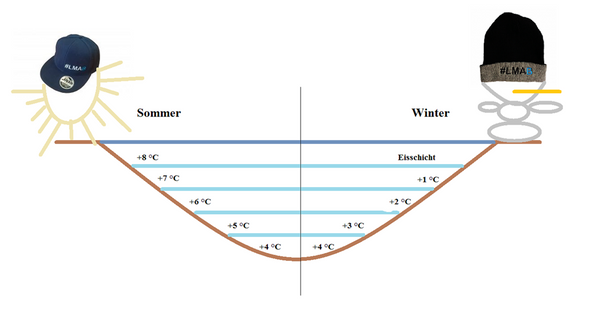
Water layering in summer and winter
Preparation for Trolling
To target those spots precisely, you need two things above all: a depth chart and a GPS-capable device. On larger waters in particular, this lets you navigate directly to the right positions, saving a great deal of time — and, if you're rowing, a great deal of effort too. These days you don't even need a GPS fish finder to track your position; a smartphone usually does the job perfectly well.
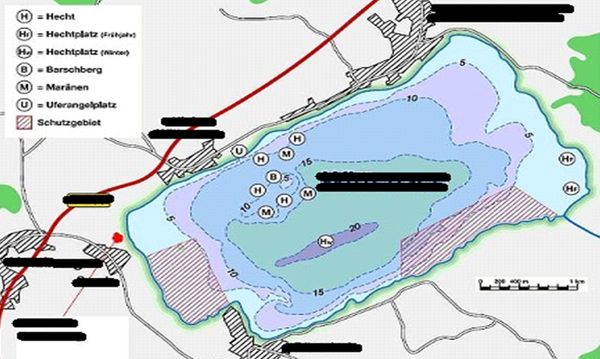
Studying water maps beforehand saves time and effort!
To pinpoint the exact location of fish and the precise depths, a fish finder is a huge help. You can manage without one, of course, but why not use it if you have access to one? It saves time and gives you far more confidence in your chosen spot.
Stick it out at the spots you've chosen and keep going — you'll be rewarded more often than not.
Techniques for Winter Fishing
In low temperatures it's important to present your lure slowly, to tempt pike that are running on energy-saving mode. The best methods for this are trolling or vertical jigging with a gentle drift.
Trolling
In this article we want to focus specifically on trolling — a highly effective method for drawing lazy predators out of their lethargy. When trolling, you can of course rest your rods in a dedicated rod holder and react as soon as something registers in the rod tip and/or the drag.
Hand-Held Trolling
Far more effective, however, is hand-held trolling. This requires a second person, so that one of you can concentrate on steering the boat while the other focuses on holding and working the rods. With this approach the lure moves far more enticingly than with conventional rod-in-holder trolling. You can react to bites much more quickly, and the lure presentation is anything but monotonous — you're constantly varying the movement, pausing, or giving a sudden burst of speed.
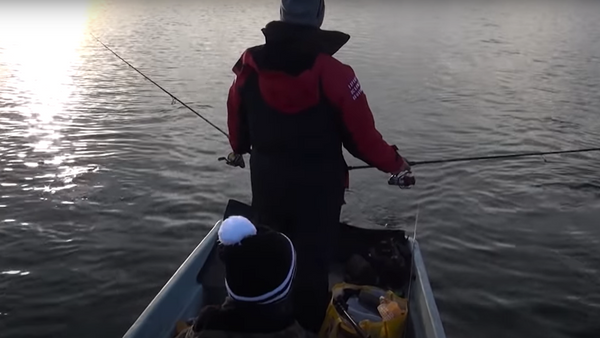
For hand-held trolling, cast the lure a rod length (20–30 metres) behind the boat and let it sink to the bottom. Once it's down, give it a single jig and begin your trolling with slow, steady strokes. The key is to troll really slowly and keep the lure close to the bottom. Whenever you feel bottom contact, pause briefly to check that the lures are weed-free and running correctly. This genuinely simple and affordable method is one we'd recommend wholeheartedly — we've tried it ourselves and it delivers.
Warning:
Bites come hard and without warning. Even after hours with no sign of fish, it's vital to stay focused and be ready to strike at any moment.
Tackle for Trolling
Lures
Think big baits. As mentioned at the start, pike are very lethargic in winter and reluctant to expend much energy. So if they do decide to commit to an attack, it has to be worth their while — fish large lures to offer an attractive meal. Pull out the lures that always feel too big in summer and trust yourself to use them. Pike need to be provoked in winter. Nothing triggers aggression like, say, a 40 cm Real Eel snaking right through their living room.
Rod & Reel
Your tackle can be kept simple. A spinning rod with a casting weight from 50 g upwards and a size 4000 fixed spool reel loaded with braid will have you perfectly set up for hand-held trolling for big pike.
Leader & Jig Head
When it comes to leaders, opinions often differ — and that's perfectly fine. Many experienced anglers, including several of our team members, always recommend using a wire trace for pike fishing.
On the subject of leaders, Toni filmed an entire episode with Enrico di Ventura back in summer 2016:
Personally (Meik & Ole), for trolling for pike we mostly use a 60–90 cm hard mono or fluorocarbon leader of at least 1 mm in diameter, though wire works well too. Soft lures are rigged on jig heads from 30 g upwards, depending on how deep the water is and how fast you want to troll. The best approach is to increase the weight until you get regular bottom contact, then drop back down one step.
Soft lures from 15 cm in length should be fished with a stinger; from 25 cm, use 2 stingers, as bites often come short.
Summary
Here are 5 tips for pike fishing in winter:
- Warm clothing and enough food and drink. This is probably the most important tip of all — it's the only way you'll last the full day on the water and be there for every feeding spell.
- In winter, scent is often king! Pre-flavoured lures or soft plastics treated with paste or marker pens regularly make the difference.
- Bring patience. Feeding windows are often short, so stay focused and keep going — you will be rewarded.
- Try new and unusual lures. On heavily pressured waters, pike can become wise to the standard offerings, so don't be afraid to get creative.
- Know your water. A depth chart and GPS device help you read the structure and use it to your advantage.
To finish, here's a trolling video from us — in case you haven't seen it yet:
This is our first article for pikeandperch.eu and we hope you found it informative and useful. We wish you big pike and tight lines. PETRI GEIL BOYS and GIRLS!!!
Meik & Ole