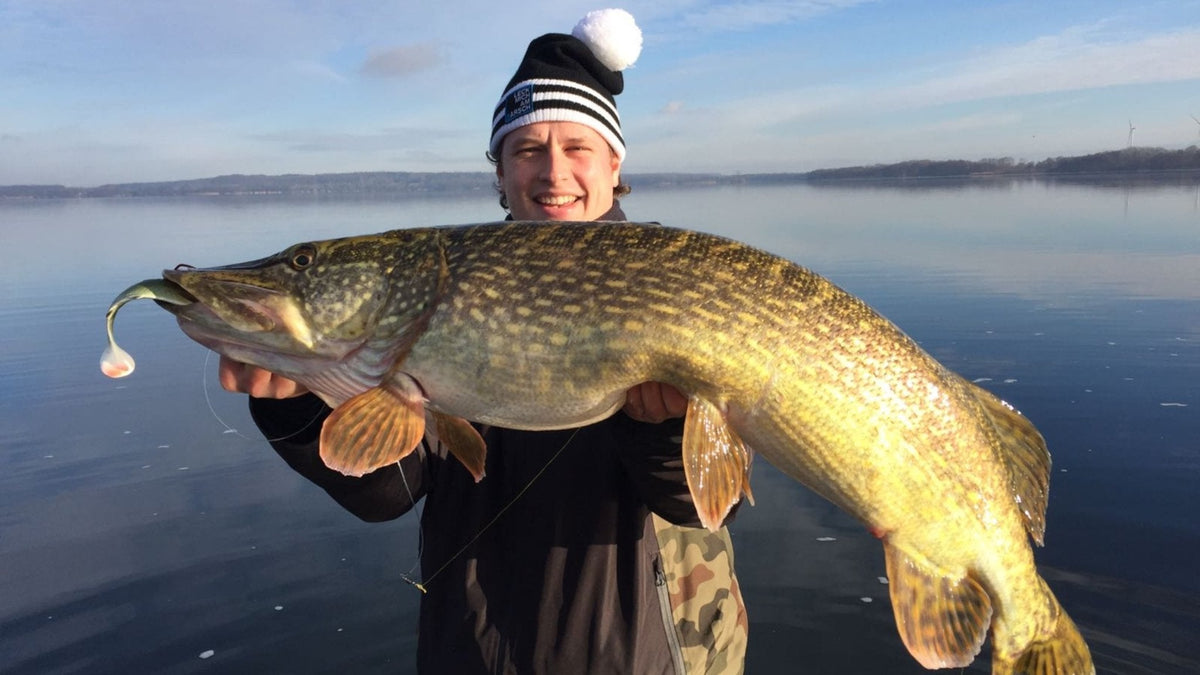
Open water, waders, long-distance casts with spoons and a whole lot of patience – that's what most anglers picture the moment sea trout fishing comes up. But there are other ways to outwit that notorious 'fish of a thousand casts', and other places to do it too. Read on to find out how.
Something Different: Sea Trout in the River
I've spent almost every summer since childhood at my parents' holiday house in Denmark, and even though spring and autumn are generally considered the prime seasons for coastal sea trout fishing, I've managed to tempt a few 'silver bars' out of a certain little river there every July and August. Compared to wading the coast, fishing for sea trout in a river is incredibly varied, close to nature and genuinely exciting – if you haven't tried it yet, you really should. Here, then, are a few tips for making a success of it.
Target Species: Sea Trout
First, it helps to get familiar with the sea trout's life cycle. Like salmon, sea trout are anadromous salmonids that enter freshwater primarily to spawn, spending the rest of their lives at sea. The structure and location of the rivers they run have a major bearing on when they move and how they behave.
In the relatively shallow river I fish – which is heavily dependent on rainfall – the first fresh-run fish, known as 'grilse-clean' fish that are neither in spawning condition nor on their way back from spawning, begin to appear as early as May, pushed upstream by fluctuating water levels.

From June onwards the first summer fish arrive, and by July and August you'll find sea trout of all ages moving upriver ready to spawn. Smaller, not-yet-mature fish – known as 'Greenland' sea trout – also run the lowland rivers during these summer months, typically moving up from the warm, oxygen-poor coastal shallows into the more oxygen-rich river stretches during the dark evening hours to feed. You're most likely to encounter these smaller fish after dark. There's certainly no shortage of fish in the river during July and August – the question is where to find them.
Spots and Holding Areas
Sea trout in a river tend to choose their lies based less on the immediate food supply and more on current conditions and shelter from predators. Classic spots include the outside bends of the river (cut banks) with deeper pools and overhanging banks that give the fish somewhere to tuck in.
If a spot doesn't produce straight away:
Don't give up too quickly!
Sometimes a single large trout has claimed the pool and driven everything else away. With a little patience and the right lures, you may well get it to take. Deeper holes, scoured-out pockets and small pools aren't only found on the bends, though – look for any place where there's a change in current speed. Behind larger boulders or rock formations, and at the tail of any narrowing where the water accelerates and then scoops out a depression downstream, you'll very likely find a fish holding on the current seam, waiting for prey.
Wide, shallow gravel or sand bars with little flow are generally best avoided. The tidal, brackish sections closer to the coast (estuaries), on the other hand, are well worth fishing – particularly in the evening, when the chances of a 'feeding trout' are quite good. Because the current direction and salinity change every few hours with the tide, sea trout in these sections don't hold fixed lies but tend to move up and down the slightly deeper central channel. In my experience, the ebb tide in particular offers good chances of a 'havørred', and at times the action can be surprisingly consistent.
Tackle and Technique
Since I haven't (yet!) mastered fly fishing, I can only offer tips on lure fishing – which is every bit as effective. For typical lowland rivers, shorter rods with a light to medium casting weight and a through action work well, and they match the lures you'll be using too – more on those shortly.
A responsive blank makes precise short-range casting much easier, and it's still capable of playing bigger fish through hard runs in strong current. I fish a 1.90 m rod rated 5–20 g, which also lets me cast from between bushes or punch underhand casts beneath overhangs.
As a general rule:
The bigger the river and the fewer casting restrictions at a given spot, the longer the rod ;-)
Longer rods do have the advantage of cushioning runs a little more effectively and of letting you present a lure to a spot with less disturbance, since you can keep further back. The reel should be balanced in weight and size to the rod, and spooled with braid (0.08 to 0.12 mm), since snags are common in these rivers and the low stretch of braid makes it far easier to pull free.
If you fish a lot with plugs or only have very stiff blanks, a good mono can be a real relief on your wrist and help to avoid dropped fish, thanks to its stretch acting as a buffer. I also use a leader of around 100–150 cm of fluorocarbon (0.22 to 0.30 mm diameter). This serves two purposes here: fluorocarbon is considerably more abrasion-resistant than mono, making it far better suited to sharp-edged stones, and it's also less visible in clear water, reducing the chance of spooking fish. At the end of the rig, always use a swivel and snap – many of the lures used here generate significant line twist in the current, and a swivel will save you a lot of frustration and missed takes.
Lure Choice and Presentation
When it comes to stocking your tackle box for river sea trout, less is more. Sea trout can be tempted on a wide range of small and very small lures, but hard lures really come into their own here.
That said, I want to share a little tip that a few older Danish anglers passed on to me:
When there's a high concentration of ragworms close to the coast, rubber worm imitations (6–10 cm) can sometimes be the key to getting fish to commit.
The same goes for small, slender soft lures. Both should be scented – a shrimp flavour works well. Because short jig heads often result in missed takes, anglers fishing soft plastics here use a simple trick: tie a single hook or double hook on a short mono leader, thread it through the rear third of the lure from the top using a baiting needle, and pull it through up to the hook shank. You can present these on any finesse rig, or with a sliding lead in front.
Spinners and Spoons
Wide-bladed spinners in sizes 3 and 4 have proven themselves here, along with slim spoons that really earn their keep in the outside bends and deeper pools mentioned above. Almost weightless old-school 'polder' spinners are equally reliable – you can work them through varied riverbed structures without snagging. Most fish seem to respond best to metal lures worked slowly downstream, probably because they represent easier prey. It's also fair to say that small baitfish rarely swim hard against a strong current when fleeing.
During the day I favour silver (especially reflective foil finishes), white, chrome-blue and chrome-red; at dusk I switch to black and fluorescent white. I also like to 'tune' my spinners with single hooks or red feathers and red wool. In heavily fished stretches, it's well worth giving 'blade baits' a go too.
Crankbaits
On the waters I've described, the go-to crankbaits are floating, shallow-running models between 3 and 7 cm, with a slim profile and a tight, high-frequency action. This type of lure has a particular advantage on overgrown natural waterways:
You can let them drift on the surface under even the deepest overhanging bushes – spots you'd never reach with a conventional cast!
Simply release the lure with the bail open, close the bail once it's drifted behind the overhang, then retrieve slowly or work it with short pauses. Alongside the colour patterns mentioned earlier, yellow-orange is always worth a try here too.
I hope you've enjoyed this second blog entry! Maybe you'll soon get the chance to put one or two of these tips into practice – I wish you the best of luck. I'd love to hear your thoughts and feedback in any form. Until next time – and 'knæk og bræk', as the Danes say!
See you soon! Lieske