A piece by Pike & Perch team angler Toni Wittbrodt
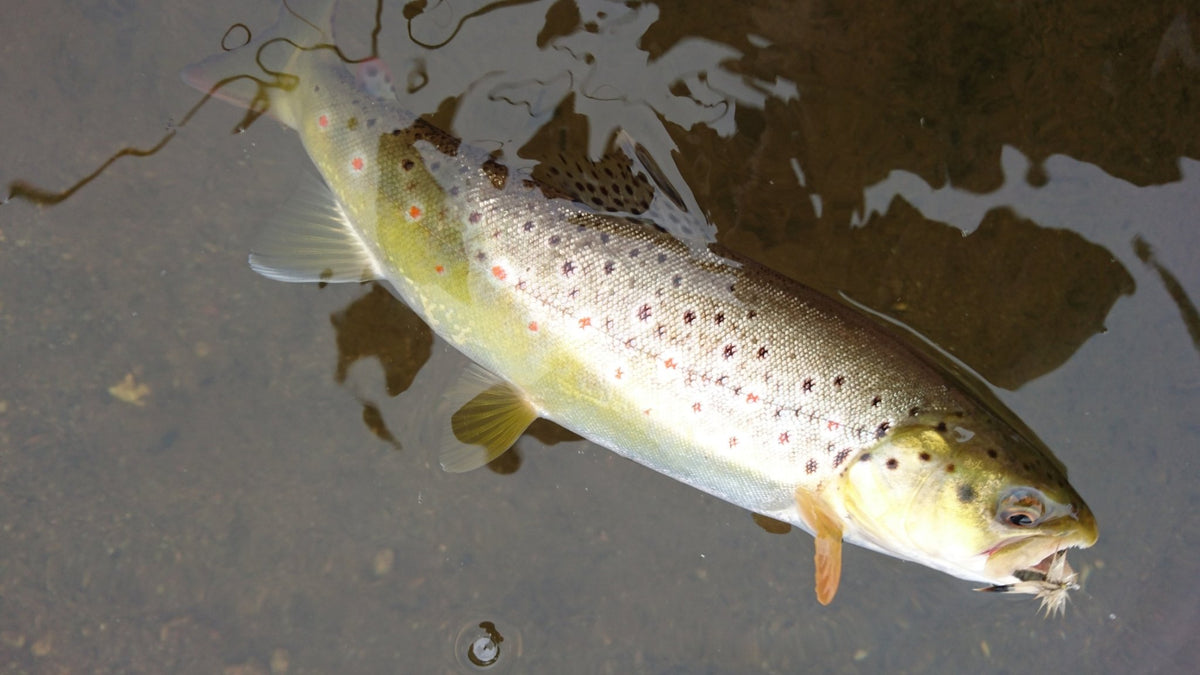
The sea trout — the fish of 1,000 casts. There is no question that catching a sea trout is no easy feat. Beginners and experienced anglers alike often come home empty-handed when chasing these silver bullets. In a way, that is part of the mystique and the fascination that surrounds this fish. But then there are those truly magical sessions that make it all worthwhile. Alongside a necessary pinch of luck, there are a number of things you can get right.
What Really Matters When Fishing for Sea Trout?
As with most species — but perhaps even more so with sea trout — it is extremely important to pay attention to environmental factors, food availability and the time of year. That is the real key to success. A quality rod and an expensive lure can make the last few per cent of difference, but knowledge and understanding are the foundation of sea trout fishing. This article aims to give you the best possible preparation for targeting sea trout. Knowing your quarry inside out is essential, so let us start with the biology and life cycle of these silver treasures.

Distribution of sea trout across Europe
Biology of the Sea Trout
First and foremost, it is worth pointing out that sea trout, brown trout and lake trout all belong to the same salmonid species and differ only in their habitat. These different forms have developed primarily as a result of habitat isolation:
- The lake trout lives in inland lakes and migrates into adjacent rivers to spawn.
- The brown trout lives permanently in streams and spends its entire life there.
- Sea trout are anadromous migratory fish that live in the sea and move into freshwater to spawn.
Life Cycle of the Sea Trout
Sea trout typically spawn between November and January, though this varies depending on water levels, weather conditions, the size of the river system and regional factors. The sea trout travels far up river systems, right into the smallest headwater streams, to spawn over extensive gravel beds. A hen fish can lay 1,000–2,000 eggs per kilogram of body weight.

Sea trout migrate from the sea into freshwater to spawn
The survival rate of the fry is around 60–70%. After one to two years, the young sea trout begins to take on a silver colouration — before this stage, it is almost indistinguishable from a brown trout. This process is known as smoltification. Shortly afterwards, the sea trout migrates out to sea. The various names and forms of sea trout confused me at first, so here is a quick rundown to save you the same head-scratching.
Different Life Stages and Forms of the Sea Trout
Juveniles from around 3 cm in length are known as parr, recognisable by the dark markings along their flanks. After one to two years and at a size of roughly 15–20 cm, the young fish begin to turn silver — this stage is called a smolt. Fish that have not yet reached sexual maturity or have not yet taken part in spawning are referred to as greenland fish. These can be identified by loose scales. Fjord trout display a golden-brown colouration with black, and sometimes red, spots. These fish are usually well under 60 cm in length. They tend to favour freshwater areas and feed mainly on shrimps and small crustaceans.
Runners and Kelts
Runners are coloured fish that have begun the spawning process — the males display a distinct kype. Kelts are fish that have completed spawning.

Kelts are lean fish — the spawning process causes them to lose around 30% of their body mass
After spawning, fish can lose up to 30% of their body weight. Kelts are recognisable by their noticeably slender bodies, cloudy fins and the marks and wounds from spawning. Finnock is the term used for sexually mature trout over 50 cm.
Overskippers
Every sea trout angler dreams of hooking an oversummer — a big, powerful fish that has skipped one or more spawning seasons and is consequently in superb condition. When anglers talk about large fish, you will often hear the term herring eater. These fish tend to favour deeper water and feed primarily on other fish. Speaking of food — that is exactly what the next section covers.

For fish like this, even 100,000 casts would be worth it!
What Sea Trout Feed On
- Herring, sand eels, sprats, sticklebacks and gobies
- Ragworms and lugworms
- Shrimps and mysids (crustaceans 2–3 cm in length)
- Sandhoppers
- Squid
- Eelpout
- Frogs
- Mussels
- Land and flying insects
How Water Temperature Affects Sea Trout
Water temperature is one of the most important factors influencing trout activity. Temperature and metabolism are closely linked in sea trout. Metabolism is the ability to take in and digest food. Between 5–16°C, sea trout metabolism functions at its best and the fish are very active. The optimum range is 12–14°C, which also applies to the food available to sea trout. Below 3°C and above 18°C the fish become very inactive, and it becomes significantly harder to get a bite.
Tactics for Year-Round Success
Winter Sea Trout Fishing
In winter, greenland fish and oversummers are the main focus, as the other forms are occupied with spawning. December is often particularly productive, as the water can still be relatively warm at that time. The primary food source during this period tends to be sandhoppers, though gobies and shrimps also feature. The middle of the day often produces fish, as the water is typically at its warmest then. Once the water temperature drops below 3°C, it generally becomes very tough going. Look for areas with soft, muddy substrate, large kelp beds or rocky (dark) stretches of coastline, as these retain heat best. Bright lure colours often outperform natural ones.

In winter, seek out the 'warmer' zones in the water
Spring Sea Trout Fishing
March and April are often the best months. At 4–7°C the fish are active throughout the day — you can have some truly outstanding sessions. From 7–12°C, sea trout are at their physical peak, which has a positive effect on bite frequency. Natural patterns, a fast retrieve and covering plenty of ground are often the keys to success.
Summer Sea Trout Fishing
Summer sea trout fishing is mostly about the twilight and night hours. Spots with strong currents close to deep water often produce. Offshore winds push warm surface water away from the bank, allowing cooler water from depth to move in — which in turn draws the trout into the shallows. Subdued lure colours dominate in summer; at night, black lures do the business. In this period I favour an extremely fast retrieve.

In summer, head for the cold currents
Autumn Sea Trout Fishing
The morning hours are often excellent in autumn. Covering longer stretches will bring you to the fish. The trout can be anywhere at this time of year and there is plenty of food in the water — so they can afford to be selective. Once the water temperature drops below 14°C, sea trout become very active again as they look to build up reserves. Subdued lure colours work very well in autumn too.
Lure Fishing for Sea Trout
For me, lure fishing has enormous advantages over fly fishing when targeting sea trout. You can fish effectively even in strong wind. It is easier to work a lure at speed. Larger lures are simpler to handle. You naturally get better casting distance and can cover ground more quickly. These are just a few of the advantages I would not want to give up.
Rod, Reel and Line
For bank fishing for sea trout, longer rods up to 3.15 m are advantageous for casting distance and cushioning hard runs — though I have also achieved excellent distances and played fish confidently on considerably shorter rods. A lot comes down to whether the blank loads well during the cast; it should not be too stiff. Shorter rods are also better suited to twitching plugs.
For Sbirolino fishing, very long rods of around 3.15 m are important, as they make it easier to cast the long leader that sits behind the casting weight. For the reel, 2500–5000 size models are most commonly used. Look for saltwater-rated reels with a high gear ratio, as this makes a fast retrieve much easier. It is also important to look after your tackle — a hunter would not go out with a rusty weapon, after all.
I use braided line with a diameter of 0.10–0.15 mm. A naturally coloured line in green or grey is always a safe choice. In front of this I attach a fluorocarbon leader that should be at least one metre long with a breaking strain of at least 0.30 mm diameter — this handles large fish comfortably.
Lures
Spoons and coastal plugs are probably the most commonly used lures, and I am more than convinced by both. Do not just crank spoons back steadily — pausing the retrieve often triggers a bite. Coastal plugs have the advantage that you can work them with a proper jerking action, which active sea trout also love. Plugs can be worth their weight in gold on difficult days. Cranked back fast, they will tempt even wary fish.
My Top 5 Sea Trout Lures
- Hansen Fight
- 3D Line-Thru Sandeel by Savage Gear
- Spöket by Falkfish
- Thor by Falkfish
- Seeker by Savage Gear
The Sbirolino Rig
In Germany you do not see many anglers putting their faith in this technique. Granted, a Sbirolino rig casts differently from a spoon, but it is no less effective. The Sbirolino itself acts as the casting weight. I prefer models that either allow you to add water to adjust the running depth, or those fitted with interchangeable weights that you can add or remove as needed.
The range of lures you can use with this set-up is particularly wide. Light spoons, plugs, soft lures, flies, streamers or spinners can all be used. Between the Sbirolino and your lure, attach a fluorocarbon leader of 1.5–2 m in length. Give it a go — it will not disappoint.
Other Essential Gear
A good pair of waders is a vital piece of kit. They let you wade out further and keep you protected during the colder months. I now only use models with felt soles, which provide excellent grip on smooth rocks along rocky stretches of coastline. A wading staff is a real asset in stony areas — no fish in the world is worth breaking bones over.
A rucksack with a little tackle, food and drink should be enough to get you through the day. A bulging tackle bag makes little sense when sea trout fishing — a small selection of lures, some fluorocarbon, a landing net and a few snaps are all you need. I often carry a thermometer too, which helps me early in the season to locate warmer water — and with it, the sea trout. I hope this piece has been useful and that you can take at least one helpful tip away for your next sea trout session.
Summary
Focus on the essentials and stay persistent — sooner or later, success will come.
Do not be distracted by the walls of colourful lures in tackle shops. The rule of thumb is:
- 70% spot selection,
- 20% lure choice and
- 10% lure presentation
With that, I wish you the best of luck and tight lines,
Toni