





A blog post by team angler Jonas Wille
When you think about trout fishing, the classics come to mind: spinners, small plugs on a spinning rod, or fly fishing. But there's another way to present flies attractively and effectively on a spinning setup — and that's exactly what I'll walk you through in this article!
What Makes Lure Fishing with a Fly Special?
For the lure angler, the fly is probably the most overlooked bait of all. A costly mistake! Fished on a spinning rig, a fly can be worked at spots where hard lures, spinners and soft lures on a jig head simply fail to produce — and it regularly puts extra fish on the bank.
The Rig
The rig itself couldn't be simpler: all you need is some fluorocarbon, a small pear-shaped weight and a fly.
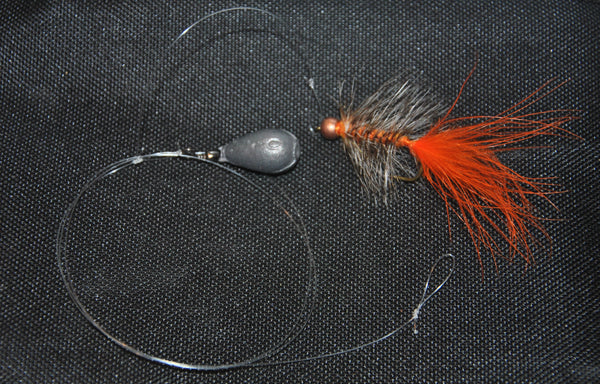
'Woolly Bugger' on a drop shot rig with a side arm
Fluorocarbon
Don't go too light on the diameter here. Because of the way the rig is worked, you'll have plenty of contact with branches and rocks, so don't drop below 0.18 mm.
Fly
When it comes to choosing the right fly, you can draw from almost the entire spectrum of fly types — nymphs, streamers, wet flies, you name it. Personally, my go-to is a time-tested streamer: the 'Woolly Bugger'!
Weight
A simple small pear-shaped sinker or a drop shot weight does the job. Choose the weight according to the current — as a rule, 7–10 g is plenty. The whole thing is tied as a drop shot rig with a side arm and fished on a light spinning combo. Simple, but effective!
Presentation and Spots
This approach works particularly well when fishing deep pools and channels with strong currents.
Bear in mind that the bottom shouldn't consist entirely of loose rock, otherwise you'll lose too much weight.
You can fish this rig in three different ways:
- Hopping and jigging
- Twitching
- Drifting
For drifting, stick to wet flies and nymphs. Hopping and jigging should be familiar to any lure angler — you let the bait bounce along the bottom using the rod and reel. With twitching, similar to drop shotting, you leave the rig in place and animate the fly on the spot with small, gentle rod twitches. Using lighter weights and the current, you can let wet flies and nymphs drift in a controlled manner past the productive spots, imitating a drifting insect larva. Another advantage of this rig is that it can be worked effectively with, against and across the current.

Summary
| Advantages | Disadvantages |
|
|
Tackle:
- Ultra-light or medium-light rod
- 1500 or 2000 size fixed spool reel
- 0.10 mm braid or 0.20 mm fluorocarbon as main line
Thanks for reading! I'd love to hear your thoughts in the comments. It's a genuinely exciting and effective method — give it a go on your next brown trout trip!
Tight lines!
Jonas