Tastes differ, as they say – but for me, topwater fishing is one of the most exciting ways to fish. It's one of those things where I ask myself: 'Why on earth did I not start this sooner?!' Even fish you don't hook stay in the memory thanks to the spectacular strikes. In this guide, 'The Complete Guide to Topwater Fishing', I want to share everything I've learned so far. Which surface lures do you actually need, which line is best, and what little tips and tricks are worth knowing? Nobody's born an expert, of course – so if you have further advice or suggestions, I'd love to hear from you in the comments!
Target Species: What Fish Can You Catch on Topwater?
The species I've had the best results with are:
- Asp
- Perch
- Pike
You can certainly target other species such as chub and trout on the surface too, but I haven't had any real success with those yet – which is probably down to the waters I fish.
Asp on Topwater
On Rivers
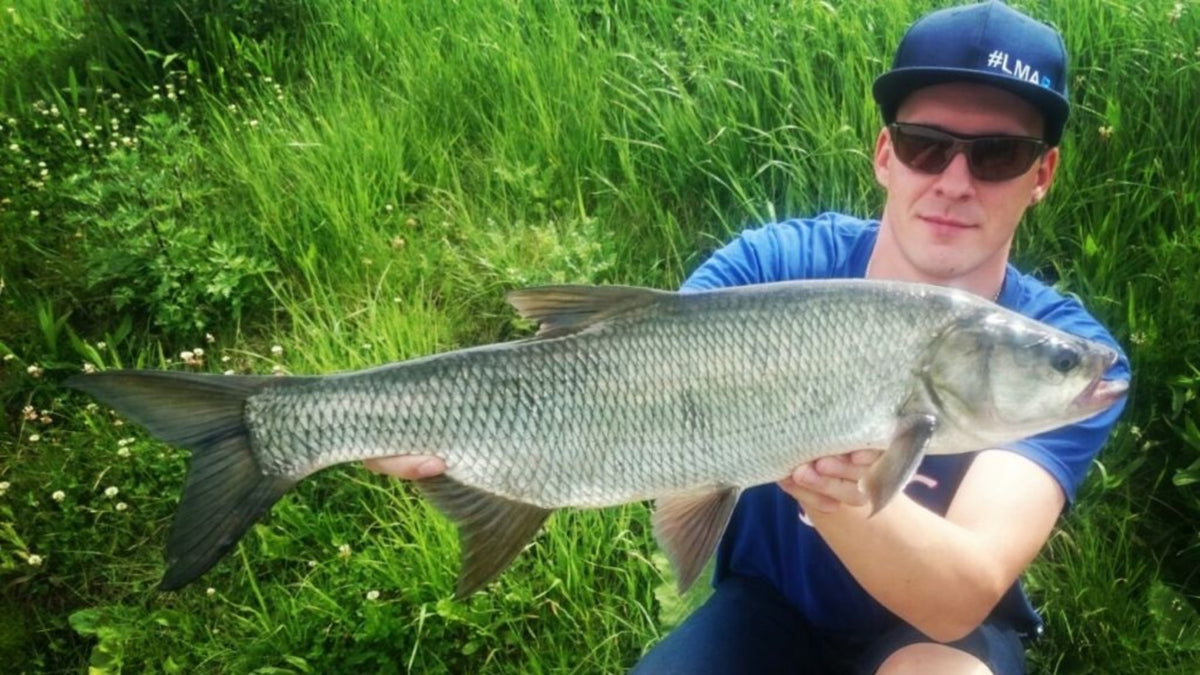
The strikes from asp are something else – lightning-fast attacks that seem to come from nowhere! Even on missed takes, these hard-fighting silver torpedoes will often make a second, third or even fourth lunge at the lure. Heart-stopping stuff. Asp can be found in good numbers across many waters, including the River Spree right in the centre of Berlin.
Typical hotspots are: rapids, weirs, locks and bridges – anywhere the current picks up. In our region, though, you can realistically expect an asp attack at almost any point along a river.

Daniel's asp caught while street fishing
On Lakes
For a long time, I hadn't even considered it: asp in a lake? But some lakes hold surprisingly good asp populations. A friend showed me his local water – a lake that practically screams pike, but which also holds a fantastic head of asp.
Even though it seemed unusual at first, here's how I make sense of it: the lake has a small inlet from the Spree. My theory is that a few asp found their way in at some point and simply stayed. For that particular lake, I tracked down a study showing that dissolved oxygen levels drop by 50% below 2 m depth in summer, and anaerobic conditions – no oxygen at all – set in below 4 m. This pushes potential prey fish towards the surface, which is ideal for any predator that hunts upwards – like the asp.
An important note on asp:
Very fine-wire treble hooks bend open quickly. Good topwater lures come with strong trebles as standard – but on some you'll need to upgrade them yourself.
My lure choice: stickbaits (worked 'walk-the-dog' style for a zigzag action) in sizes of 5–10 cm – smaller at the start of the season, working up in size as the year progresses, mirroring the growth of the year's fry. Poppers haven't worked as well for me on asp, but I'm sure others have had different experiences.
Perch on Topwater
Perch sometimes chase surface lures in frenzied packs – and one of the great joys is watching it all unfold right in front of you. Perch often 'slurp' lures off the surface, but you do occasionally get savage, high-speed strikes that are simply breathtaking. Lures of 5–10 cm work best, worked 'walk-the-dog' style at a slightly slower pace than for asp, since perch aren't quite as precise and will often miss the lure at high speed. Poppers are also a solid alternative if that's your thing.

Pike on Topwater
When it's working well, a pike will screw itself vertically out of the water to engulf the lure. The strikes are powerful, and larger lures well over 10 cm are perfectly at home here. There's a clear trend at the moment towards 'real topwater baits' – for example the 3D Suicide Duck from Savage Gear. Frog lures like the River2Sea Spittin' Wa (a cross between a frog and a popper) also work brilliantly for pike. These can be fished right through thick weed and lily pads, as the hooks sit tight to the body and are effectively hidden.
The downside: you need to time your strike very precisely – the miss rate is high. But when the attacks are this spectacular, it's easy enough to forgive!
Tip: Barbless Treble Hooks
Even small perch apparently have no qualms about attacking larger lures – which often results in the treble catching on the outside of the fish. With lures that are too small, I've found the opposite problem: perch swallow them deeply, and removing the hook without causing harm is a real struggle. Neither outcome is ideal – not the outside hook-up with an oversized lure, nor the deep-swallowing with one too small. An outside hook-up in particular often sees the treble sitting close to the eye. For this reason, I spent last winter switching almost all my surface lures over to barbless treble hooks. I've only had three to four months of practical experience so far, but the loss rate hasn't noticeably increased.
I was a little worried at first about the lures running differently (less so with topwater baits, more so with regular twitchbaits).
Here's how I solved that: I ordered every size of treble hook available (and in different wire strengths), then used a precision scale (around €10 on Amazon) to match the right hook to each lure by weight.
A further advantage: the risk of injuring yourself drops enormously without a barb. You can simply pull the hook free rather than having to push it through.

Matching treble hooks using a precision scale
Lures
The range of topwater lures is enormous. Here's a far-from-exhaustive overview of the main types.
Stickbaits
The all-round weapon for every target species. The 'walk-the-dog' action is created by twitching the rod tip with short, sharp strokes. The intensity, frequency and retrieve speed all influence the action – at a slow pace, the lure can almost work on the spot. A very fast presentation is equally possible. A rapid retrieve combined with high-frequency light twitches will send the lure skimming across the surface – often the key trigger for asp bites. Perch, on the other hand, tend not to connect well with this very fast, aggressive style of retrieve; they simply miss the lure too often and the hook-up rate drops sharply.
Another big advantage of stickbaits: most cast enormous distances. The absence of a diving lip and the built-in balance weight system send the lure flying. Here's a selection of my go-to stickbaits:
Poppers
Easy to identify by the concave 'face'. With the right retrieve, you can produce a popping sound. How quickly you can work a popper depends very much on the individual lure – some rise nose-up very slowly, others almost instantly. I like it when the face is a contrasting colour so you can clearly see when the right moment for the next rod stroke has come. Once you've fished the same lures enough times, though, you develop a feel for it anyway.
Honestly: I own a few poppers, but they account for no more than 5% of my fishing time. They're not really my thing, and a stickbait just seems to outfish them more often than not.
Frogs
As mentioned above, frog lures allow you to fish without frustration through thick weed and lily pads. For me, though, they're strictly a pike lure. Keep one in your lure box at all times so you're ready when the opportunity arises. I haven't tried them on perch yet. I've just picked up a Kahara Baby Diving Frog for that purpose – still unused at the moment. Time to change that.
Tip for frog lures:
If your miss rate is too high, you can carefully bend the hooks out by 1–2 mm so they don't sit too close to the body.
Prop Baits
At first glance you might confuse prop baits with stickbaits, but the action is completely different. Depending on the model, prop baits have a small propeller at the rear, the front, or both, which creates an interesting noise as it spins through the water. They also run in a straight line, making the prop bait a perfect complement to the stickbait. On plenty of days I've tricked a late asp on a prop bait after 'walk-the-dog' had produced absolutely nothing. In my view: a must-have in 2–3 sizes!
Crawlers
Easy to spot by their 'arms' or 'wings', which make the lure crawl and splash across the surface. This creates gentle splashing sounds intended to draw in predators. Most models are unfortunately difficult to cast, so you won't be covering great distances with them.
Splash Baits and Other Lures
Splash baits sit somewhere between a popper and a stickbait – a genuinely interesting option. The exact action and popping character vary considerably from one lure to the next. Also very exciting, and hugely popular in the USA, is the River2Sea Whopper Plopper. It's tricky to categorise – not quite a prop bait, not quite a splash bait either.
Another interesting oddity is the River2Sea Double Plopper, though I've yet to put it through its paces in practice. It's essentially a topwater spinnerbait and falls into the 'buzz bait' category.
Lure Colour
In my view, lure design and colour is 90% aimed at the angler – in other words, it's marketing.
Many lures have elaborate patterns on the back and are simply white or grey underneath. That said, stickbaits do flash their flanks, so the underside colouring becomes more relevant than on static lures. After watching a lot of videos from the USA, I noticed that surface lures with a black underside are very common over there – the River2Sea Whopper Plopper in 'Yellow Head' or the River2Sea Rover 98 in the same finish, for example. The contrast from a fish's perspective is presumably greatest with a dark belly.
My take:
Colour matters less in topwater fishing than it does with, say, soft lures.
Noise and Rattles
Many stickbaits come fitted with rattles, ranging from loud and attention-grabbing (Illex Bonnie) to subtle clicking (Duo Realis Pencil 85), right through to completely silent models (Megabass Dog X Speed Slide).
The following observation might be in my head, but I can't quite let it go – and my fishing partner Ronny, with whom I've spent many hours topwater fishing, sees it similarly: at several bridges in Berlin where there's a lot of traffic noise, the loud Illex Bonnie consistently outperforms quieter lures like those from Megabass.
It's also worth mentioning that Livingston makes lures that produce insect sounds via a built-in battery and speaker. No personal experience with those yet – but one is now sitting in my lure box, waiting to be tested. The River2Sea Whopper Plopper is also a very noisy lure, though its sound comes from the rotating tail blade, making it far more natural-sounding than a mechanical rattle.
My tip:
Keep at least one of each type in the box – loud, medium and silent.
Line
I fished fluorocarbon for a long time and never had any real issues with it. These days, though, I mostly use plain mono. The reason: fluorocarbon sinks quickly, whereas mono sinks slowly or not at all. With fluoro you get a downward bow in the line, which occasionally causes the trebles to foul on it – especially when you're fishing the lure very slowly and twitching into slack line. On top of that, fluoro pulls the nose of the lure slightly downward, which can actually make a difference on very light lures like the Illex Chubby Pencil. With long casts, the twitches are also heavily dampened when a lot of line is submerged, making a clean 'walk-the-dog' very difficult. A long mono leader and holding the rod a little higher – twitching side-on – helps with this. It only really affects the very longest casts, but those are often exactly when you need it most.
For pike, though, I go back to heavy fluorocarbon – mono picks up damage from pike teeth far more quickly. Wire traces affect the lure action too much due to their weight, so they're not an option for me.
Another option worth mentioning is 'Strike Wire Stinger Baid'. I tried to get hold of some at the time, but couldn't source it in Germany. It's said to be as tough as a wire trace (or perhaps it actually is one – I couldn't find much information) while supposedly not affecting lure action. If anyone has tried it, do leave a comment.
In summary:
- Perch & asp: mono
- Pike: fluorocarbon
Knot or Snap?
In the USA, hard lures – especially topwater baits – are tied directly to the leader using a Rapala knot. The idea is that the lure gets more freedom of movement without adding any extra weight. I've tried it myself, but I swap lures too often for it to be practical – changing a knotted lure gets old very quickly. American anglers on boats can get around this by having ten rigged rods ready to go, but for the bank angler or float tube angler, the effort-to-reward ratio just isn't worth it. I simply use small, sturdy snaps and I'm perfectly happy with that.
Rod
Opinions vary here too.
I like rods that load up nicely and launch the lure a long way.
I prefer medium-light rods (actual casting weight: 5–15 g) for throwing 5–10 g stickbaits. For heavier lures like the Savage Gear 3D Suicide Duck or the Illex Bonnie 128, you'll need something with a bit more backbone. Length is the key factor: 180–220 cm is the sweet spot. Because you're twitching the rod downward, longer rods get in the way – and a long, heavy rod becomes tiring very quickly when you're constantly working the tip. A great option for this style of fishing is the Okuma One. As well as the length, the rear grip is kept slim, which makes twitching easy without the rod catching on your arm. My advice here would be to go for the lightest version (7–20 g), since the rod is very stiff and will comfortably handle the stated casting weight.
Quick Summary
- Target species: asp, perch, pike, trout, chub
- Hooks: use strong hooks for asp!
- Barbless treble hooks: kinder to both angler and fish
- Lure type: stickbaits are the all-rounders. In weed and lily pads, frog lures are the best choice (for pike).
- Lure size: 8–9 cm covers almost every species
- Balance weight system: a must-have – essential for long casts and prevents trebles tangling in the leader
- Colour: probably not critical. Black-bellied lures are on trend
- Rattles etc.: one loud, one medium and one silent lure in the box would be ideal
- Line: mono is ideal for topwater; fluoro works too. Heavy fluoro for pike fishing
- Snaps: as small and light as possible to avoid affecting lure action
- Rod: shorter is better. 1.8–2.2 m is ideal
Thanks for reading – tight lines on the topwater, and hopefully see you on a Pike & Perch tour before long!