





Our guest author Marco Solar has come through again with some useful information, tips and tricks. This time he takes us into the world of leaders. Find out here how and why you choose one leader over another, what the differences are between leader types, and what to watch out for. In this article he focuses specifically on the two most common leader materials: wire and fluorocarbon. Enjoy the read!
Wire Traces and Fluorocarbon: A Comparison with Practical Tips
Every predator angler knows that success on the bank depends heavily on having the right rig. If your tackle isn't properly matched, you're reducing your chances before you've even made a cast. This article gives you a comparison and practical tips for using different types of modern wire trace, fluorocarbon and other leader materials, including rigging instructions. We get to the bottom of the question of which leader material is best for predator fishing.
According to a survey by a well-known German fishing magazine, over 50% of all predator anglers use wire traces for pike and other predators. This is largely down to tradition — many anglers stick with the tried-and-tested wire trace. The remaining 50% use fluorocarbon, titanium, spinning rods, Kevlar (aramid fibre) or no leader at all. In the end it comes down to personal preference; every type of leader has its advantages and disadvantages. In this article I'll focus on wire traces and fluorocarbon leaders.
Which Leader Is the Best Choice for Predators?
We also answer this important question in the video:
The days when wire traces were stiff and prone to kinking are long gone. Modern, high-quality wire traces are relatively supple and have a higher breaking strain than the thick, coated wire traces of the 1990s. Nowadays there are also fluorocarbon and titanium leaders to consider.
Ready-Made Leaders or Tie Your Own?
The trend in predator fishing is moving away from ready-made leaders towards individual, hand-tied rigs. An experienced predator angler knows a wide variety of leader types and material combinations, and knows how to adapt them perfectly to the conditions at hand.
Key Factors When Choosing a Leader
Of course, when choosing a leader you need to think about more than just the lure. Everything has to suit the breaking strain of your main line and the casting weight class of your rod. Many beginners underestimate the pressure a trolled Big Bait puts on the swivel and the leader. Barrel swivels — swivels without a snap — are stronger than swivels with a snap. An ordinary snap can open up quickly, especially models without a safety lock. For connecting a hand-tied leader to the lure, snaps work very well — either as a duo snap or the extra-strong Big Bait snaps with double security.
If you're fishing a water where you expect pike of over a metre, choose every component of your tackle accordingly. When in doubt, fish a strong setup and give yourself the best chance of actually landing that long-awaited fish of a lifetime.
We can debunk the myth — from our own experience — that a cautious zander or a small perch won't take a lure presented on a wire trace.
Sure, there may be some degree of a deterrent effect depending on the water, the conditions and the method, but bite rate is not 'noticeably' reduced — at least not in our experience.
Build Your Own Leader with Enrico di Ventura:
Leaders Compared: Wire Trace & Fluorocarbon
Below you'll find a handy table comparing the different diameters, breaking strains and prices of modern leader materials for predator fishing. Fluorocarbon is also available in thinner diameters than those shown here; however, these are not recommended for targeting large predators. Diameters below 0.50 mm are used when fishing for perch and small zander in waters without pike.
Leader Overview Table
|
Leader Type |
Diameter [mm] |
Breaking Strain [kg] |
Price [€ / metre] |
|
Wire trace 1x7 |
0.28 |
9.00 |
0.795 |
|
Wire trace 1x7 |
0.30 |
14.00 |
0.795 |
|
Wire trace 1x7 |
0.38 |
18.00 |
0.795 |
|
Wire trace 7x7 |
0.28 |
9.00 |
1.990 |
|
Wire trace 7x7 |
0.36 |
12.00 |
1.990 |
|
Wire trace 7x7 |
0.46 |
18.00 |
1.990 |
|
Fluorocarbon |
0.50 |
16.00 |
0.600 |
|
Fluorocarbon |
0.60 |
19.50 |
0.800 |
|
Fluorocarbon |
0.80 |
26.20 |
0.950 |
|
Fluorocarbon |
1.00 |
33.70 |
(Prices may vary)
Wire Trace 1x7
A wire trace labelled 1x7 is made up of 7 individual strands twisted together. Compared to a 7x7 wire trace, the 1x7 is stiffer and is particularly well suited to jerkbait fishing and twitching. A 0.38 mm 1x7 wire trace has a breaking strain of 18 kg. To achieve the same breaking strain with a 7x7 wire trace, you'd need to go up to a 0.46 mm diameter.
A 1x7 wire trace has thicker individual strands and is less susceptible to abrasion from underwater obstacles. It's therefore a popular choice for predator fishing in snaggy water. The 1x7 wire trace is the first choice when targeting big pike near sunken trees in coloured water — for example with jerkbaits.
If you start tying your own leaders permanently, you'll notice the difference in your wallet quickly. You'll also have far greater flexibility in how you fish and how you rig up.
Wire Trace 7x7
A 7x7 wire trace is made up of 49 individual wires in total. Seven groups of seven strands are woven together to form the trace. The 7x7 is primarily used in open water where there are few or no obstacles. Its defining quality: a 7x7 wire trace is considerably softer and highly flexible.
A 7x7 wire trace with a diameter of 0.36 mm and a breaking strain of 12 kg makes a genuine all-round leader. Contrary to what some predator anglers believe, cautious zander and even small perch will readily take a lure on this class of wire. Lures for pike, perch and zander all move very naturally on a 7x7 wire trace.
When fishing a woven 7x7 wire trace, inspect it regularly for damage. As soon as it no longer feels supple at any point and individual wires are sitting loose, replace the trace. Small areas of damage often result from missed strikes or snagging up. Just as with a fluorocarbon leader, even minor damage to a 7x7 wire trace can dramatically reduce its breaking strain.
Particularly advantageous for lures or rigs that need to be worked with more precision. The 7x7 is softer and therefore more flexible than the 1x7 wire trace.
Fluorocarbon
A fluorocarbon leader is stiffer and less flexible than a wire trace. You use fluorocarbon from 0.50 mm up to 1.00 mm in waters that are largely free of snags, and in clear waters where big pike also live. Not every predator angler is yet familiar with this relatively modern material and its advantages. In clear water it has the benefit of being far less visible than a wire trace — though it's not completely invisible, of course. Like clear mono, it still casts a shadow.
It's important that you replace a damaged fluorocarbon leader promptly. The material is abrasion-resistant, but damage reduces its breaking strain enormously. Thinner fluorocarbon leaders are well suited to fishing for big zander and perch.
Thanks to its properties, fluorocarbon is virtually invisible underwater and therefore has a noticeably lower deterrent effect than other leader materials. It is also considerably more abrasion-resistant than braid.
Rigging a Leader: Fluorocarbon and Wire Trace
Now that you know the fundamental differences between wire and fluorocarbon leader materials, let's get to the most important part: how do you actually rig a wire or fluorocarbon leader for predator fishing? You can of course tie knots with both types, but here we'll show you the connection using crimp sleeves. A crimp sleeve is straightforward to use and provides an excellent hold. The diameter of the crimp sleeve you need depends logically on the thickness of your leader material.
Use this simple formula to determine the minimum diameter of your crimp sleeves:
(Leader diameter) × (number of passes) = (minimum crimp sleeve diameter)
For example (wire):
0.36 mm × 3 = 1.08 — the correct crimp sleeve has a 1.2 mm diameter (you go up to the next available size)
To get started, you can often pick up a ready-made leader kit in which all the key components have already been matched and assembled together.
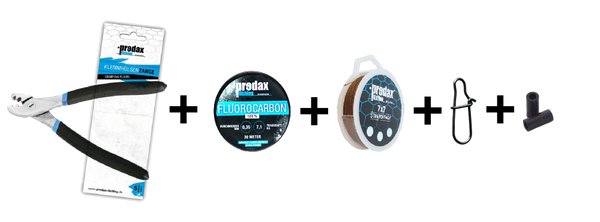
Rigging a Wire Trace
If you tie your own wire traces for predator fishing, you have far more flexibility than an angler who relies on ready-made traces. Over time, hand-tied traces also work out cheaper. If you still have questions after reading our step-by-step guide, feel free to ask them in the comments.
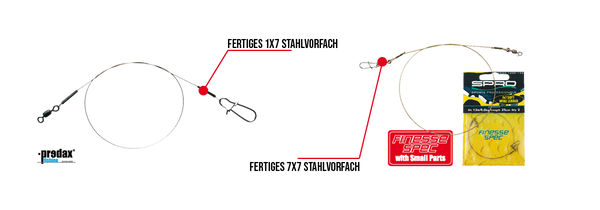
The steps for assembling a hand-tied wire trace are as follows. We recommend having all the individual components within reach before you start, and making sure you're using the right parts.
That means:
- the correct size barrel swivel (breaking strain)
- the matching crimp sleeves (diameter)
- an appropriate snap (breaking strain)
These days most anglers tend to go for longer leaders. It's easy to forget that it's not only a pike's sharp teeth that can cut through your main line with ease — the gill covers can also do serious damage.
Step-by-Step Guide to a Wire Trace:
-
Decide on your leader length.
-
Heat the end of the wire with a lighter until it turns black.
-
Cut through the wire with wire cutters or small side cutters.
-
Thread the wire through the correct crimp sleeve.
-
Thread on the barrel swivel.
-
Form a loop and pass the wire back through the sleeve in the opposite direction.
-
Bend over a short end of approximately 1 cm at the crimp sleeve.
-
Push the short end of the wire back into the sleeve.
-
You now have three strands of wire sitting inside the sleeve.
-
Hold the sleeve steady and pull the long end of the wire back.
-
Draw the loop tight (it should be smaller than the ring of the barrel swivel).
-
Carefully crimp the sleeve. The sleeve must not be damaged or cracked. The teeth of the crimping tool should be visible on the sleeve.
-
Repeat steps 1 to 12 at the snap end.
-
At step 11, draw a slightly smaller loop. The snap must not be able to tangle.
-
Check the finished trace.
Rigging a Fluorocarbon Leader
Tying a fluorocarbon leader for pike fishing follows essentially the same technique as a wire trace. There are, however, a few important differences. Here is our step-by-step guide to rigging a fluorocarbon leader for predator fishing.
For zander fishing you can knot the thinner fluorocarbon leader directly to the swivel and snap. Fluorocarbon for zander is somewhat thinner than the material you'd use when deliberately targeting pike. However, a standard swivel knot causes problems, as this knotting technique causes the material to compress too tightly on itself. Fluorocarbon also doesn't slide as smoothly over itself as ordinary mono, which means this type of knot can result in a line break.
Reversed Double Swivel Knot
For tying a lighter fluorocarbon leader properly, use the technique of a reversed double swivel knot. Form the familiar loop, but then bring the short end back up towards the swivel from above. Around five to six wraps are sufficient. Then pass the end through the upper loop and pull the wraps snug. Don't forget to moisten the knot — this prevents the knot area from getting too warm as you tighten it, and helps everything bed together more smoothly. Now draw the knot along the leader material to the eye of the swivel. Finally, pull the short end tight with pliers and your fluorocarbon knot is done. This technique is also covered in more detail in the video with Enrico Di Ventura above.
If you want to fish a fluorocarbon leader for pike, use a minimum diameter of 0.50 mm — with large lures, go up to a 1.00 mm leader. For such a thick leader, crimp sleeves are particularly well suited for rigging.
IMPORTANT:
We want to make it clear once more that when specifically targeting pike — and especially large pike — we always recommend a wire trace. It is safer and more considerate, because the welfare of the fish must always come first.
Step-by-Step Guide to a Fluorocarbon Leader:
-
Decide on your leader length and cut it cleanly with small side cutters.
-
Thread the leader once through the correct crimp sleeve.
-
Thread on the barrel swivel.
-
Form a loop and pass the leader back through the sleeve in the opposite direction.
-
Bend over a short end of approximately 1 cm at the crimp sleeve.
-
Heat the short end with a lighter until a head / mushroom forms.
-
Push the end of the leader back into the sleeve, leaving 2–3 mm protruding.
-
Hold the sleeve steady and pull the long end of the leader back.
-
Draw the loop roughly the same size as the ring of the barrel swivel.
-
Carefully crimp the sleeve using the flat front part of the pliers.
(Do not use the teeth — use only the flat section!) -
Repeat steps 1 to 10 at the Big Bait Snap end.
-
Remove the memory effect from the fluorocarbon*.
-
Check the finished leader.
Removing the Memory Effect
*To remove the memory effect from a fluorocarbon leader, stretch it taut and rub your fingers along the material. The friction generates heat and the fluorocarbon loses its so-called 'memory effect'. Repeat the process roughly 10 times from both sides until the leader stops coiling back. Turn the leader around and repeat from the other side — keep rubbing until the material feels warm between your fingers.

Stretching the fluorocarbon several times can help remove the memory effect. You can see exactly how this works in the video 'Toni's Tackle Talk' with Dietmar Isaiasch.
Summary: Leaders for Predator Fishing
A modern wire trace is definitely suitable for zander and big perch too, when used in the right water. If in doubt, always go with a wire trace if there are pike in the water. Depending on the conditions, a fluorocarbon leader can be a real advantage. In very clear water with little wind and good visibility, fluorocarbon can tempt even the wariest fish.
In a water with lots of obstacles, a 1x7 wire trace has the edge. It is more resistant to damage than a 7x7 wire trace or a fluorocarbon leader. Alongside the materials already mentioned, titanium is another option worth considering — particularly when fishing with jerkbaits or twitchbaits, where the stiffness is a real benefit.
|
MATERIAL |
VERDICT |
|
Fluorocarbon |
In good visibility, fluorocarbon will tempt even wary fish. Suitable for pike, zander and perch. A solid alternative to wire traces. Relatively stiff material. Always inspect for damage. |
|
Wire trace 1x7 |
Best in coloured water with underwater obstacles. Less flexible — primarily suited to fishing for predators with jerkbaits and twitchbaits. |
|
Wire trace 7x7 |
All-round wire trace for predator fishing. 49 individual wires woven together. Flexible with high breaking strain. Always inspect for damage. |
That covers the basics on the subject of leaders. If you have any questions or suggestions, want to share some constructive feedback or tell us about your own experiences, write it in the comments below. We'd love to hear from you. Enjoy choosing your next leader, and tight lines,
Marco.