





The Philippines are famous for their stunning islands with white sandy beaches. But how good is the fishing there? In this post, I want to introduce you to the Philippines — and above all, to lure fishing and bait fishing in both fresh and salt water in my home country.
Is the Fishing in the Philippines Worth It?
The island archipelago consists of 7,107 islands. For us anglers, that sounds immediately promising — where there are islands, there is plenty of water, and where there is plenty of water, there should in theory be plenty of fish. In the course of this short account, I want to point out what to look out for when you go fishing in the Philippines.
On my previous trips to the Philippines, I was mostly there to sunbathe and relax. I always had a compact travel rod in my luggage, but it barely came out — mainly because I had no idea where to go or how to go about it. On my most recent stay, though, things were different. This time I was there for a two-month internship and had a bit more time on my hands, along with slightly more tackle, to explore my home country as an angler. I did my research in advance on various angling forums and Facebook groups and picked up some useful tips and tricks.
Tip: Facebook groups such as 'Philippine Angler's Club' and 'Snakehead Sport Fishing Philippines' were a great help, and the members were open and willing to share their knowledge. As a native speaker, I had an obvious advantage when it came to communication — though it is worth mentioning that English is an official language in the Philippines, which makes things considerably easier for tourists with basic English skills.
Do You Need a Fishing Licence in the Philippines?
In general, you do not need a fishing licence as you would here in Germany, whether you are fishing in fresh or salt water. That said, it does not mean there are no regulations at all — there are exceptions, and plenty of waters where fishing is prohibited entirely. It is therefore worth checking online, with the local authorities, or with residents on the ground before you head out. Small and large man-made lakes that are open to anglers are usually owned by a fisherman or a local community. You can buy a day ticket for a modest fee and try your luck. Whether predators are actually present, however, is something you should establish beforehand.
Freshwater Fishing: Snakehead Fishing
Freshwater fishing in the Philippines is, unfortunately, not straightforward, as the options are fairly limited. Finding waters where you are actually allowed to fish can seem like a major hurdle at first. Many venues suffer from serious pollution and unsustainable fishing practices, leaving them with poor fish stocks. If you are prepared to do your homework and willing to travel longer distances, however, you will find waters with a healthy stock and a genuine chance of a special fish.
I did not have a car in the Philippines, so long journeys — particularly to the reservoirs that interested me most — were not an option. I had to make do with waters in and around Manila, where I was based. I did venture out to a few natural venues, but without any real success. Whether it was the wrong technique, a lack of fish, or simply fishing at the wrong times, I cannot say for certain — I did not get out often enough to find out.
My one personal goal in the Philippines was to catch my first snakehead. Knowing that these fish are freshwater predators, I was confident that my predator fishing experience from Germany would give me an edge. To pick up more tips, I visited the tackle shop 'Hook Pro' in Manila. The owner offered to take me out fishing — an offer I was more than happy to accept. A few days later, we headed together to 'Lakeshore' in Mexico (Pampanga) — a man-made reservoir that holds, among other species, enormous giant snakeheads, known locally as 'Toman'. The day ticket cost 200 pesos, the equivalent of roughly 4 euros.
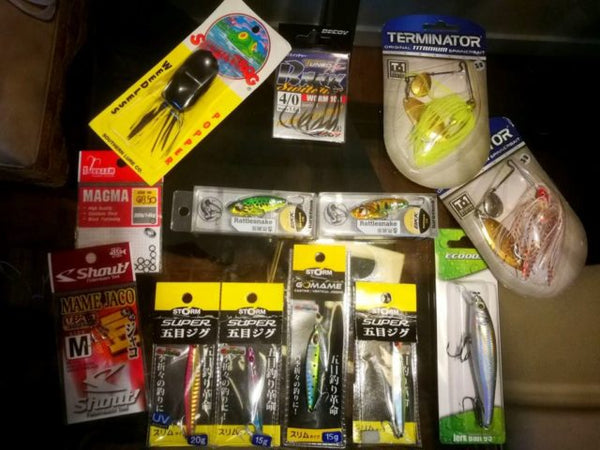
Pic 1: Preparation is everything — shopping at the local tackle shop
What Tackle for Snakehead Fishing?
At the time, I was fishing with the four-piece travel rod 'Road-Runner' by Savage Gear. For travelling, that rod is an absolute dream — its compact packed length meant it slotted easily into my suitcase and could be taken anywhere without any hassle.
I paired it with a Spro Red Arc fixed spool reel loaded with 0.14 mm braid. As snakeheads have teeth, I fished with either a thin titanium leader or a fluorocarbon leader. A diameter of at least 0.35 mm should be the minimum for a fluorocarbon leader if you want to avoid losing fish. Visibility of the leader was a secondary concern, as snakeheads tend to live in very coloured water. Snakeheads usually hunt at or just below the surface, so surface lures and shallow-running plugs were the first choice. Their typical habitat is weed beds close to the bank, which is why frogs, weedless-rigged soft lures, and spinnerbaits were my preferred options.
Where to Find the Snakeheads
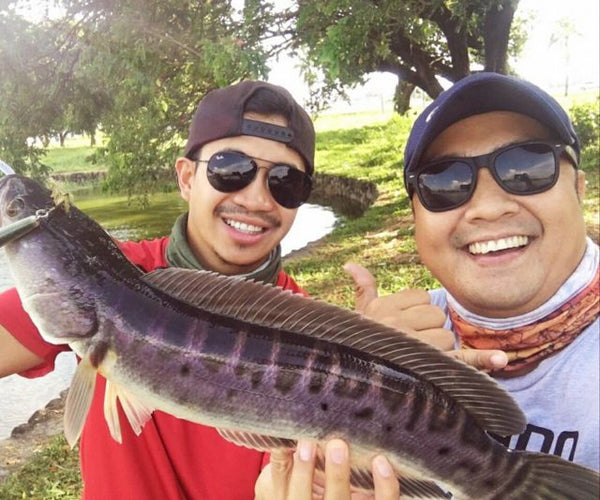
Tracking down these snake-like predators turned out to be seriously tough. The water we were fishing was fairly large, and during the day it was simply sweltering — you were forced to keep stopping for drinks and rest breaks. A face shield to prevent sunburn on your face and neck was practically essential. We had no luck in the morning, so we pinned our hopes on the evening session. After long and gruelling hours on the bank, my mate finally managed to catch a small giant snakehead in open water, using a very fast-retrieved, shallow-running, light-coloured plug. We were absolutely over the moon.
Motivated by his success, I tried my luck in open water too, but nothing came of it. Eventually my patience paid off — I caught my first snakehead on a twitched hard lure! It did not take in open water but close to the bank; staying flexible had paid off once again — what a result. I only caught a 'standard' snakehead rather than a giant, but I was told my fish was already a specimen — the scales read a proud 22'.
We drove home that evening with huge grins on our faces. I was more than satisfied — I had completed my first mission in the Philippines.
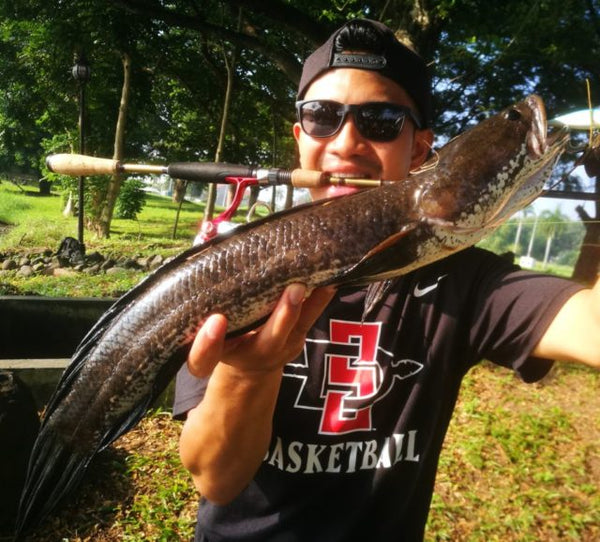
Mission completed — my first snakehead!
Snakehead Fishing: Summary
Tackle for Snakehead Fishing in the Philippines:
-
Rod: Savage Gear Roadrunner:
- Casting weight: 20–70 g
- Length: 2.13 m
- Reel: Spro Red Arc 10100
-
Line:
- Main line: Stroft GTP Type S
- Leader: Predax titanium leader 0.3 mm; Predax fluorocarbon 0.4 mm
Lures:
- Frogs
- Poppers
- Spinnerbait
- Soft lures (Keitech Easy Shiner, Fox Rage Firetail, Westin ShadTeez, …)
- Plugs (Westin Fatbite 5.5, Lucky Craft Pointer, Illex Squirrel, Megabass Vision Oneten, …)
Salt Water Fishing: Jigging and Trolling
Salt water fishing is the better-known option in the Philippines. Many locals head out every day in their boats onto the open sea, trying to catch fish with nets or handlines — usually to make a living. At the same time, salt water fishing in the Philippines has become an expensive hobby, one that most people there can only afford if they are on a higher-than-average income.
Lure fishing in salt water in the Philippines can take many forms. There is simple light jigging with small metal lures from the shore, then heavy jigging — usually with lures over 60 g — from a kayak or boat targeting amberjack or giant trevally, and of course big-game fishing for large marlin or tuna from motorised boats. If you do not want to try to find the fish on your own, you can simply book an organised charter — these are mostly offered by American guides.
My Salt Water Experience
For the salt water fishing, I was honestly not very well prepared — neither for active lure fishing nor for trolling for large predators. On the one hand, I did not want to fill my entire luggage with tackle; on the other, I rarely go salt water fishing in Germany and simply do not own the right gear for it.
Rods with a casting weight of over 100 g, for instance, are already fairly extreme for freshwater anglers, yet they are completely standard for salt water fishing. Despite all that, I did not want to miss the experience and made enquiries about it too. I was told in advance that the trolling season does not really get going until October. As it was August, I was not expecting much from trolling — pulling even a small predator out of the sea would have been more than enough for me.
Spot: The Sea off Bataan
For the salt water session, I was once again invited by my friend to his home village — this time in the province of Mariveles in Bataan, a place he knew like the back of his hand. The plan was to start the morning with light jigging from the shore, take a midday break to escape the worst of the heat, and then in the evening head out on a motorised outrigger boat — called a 'Banka' in Filipino — to troll for large predators such as tuna, amberjack, and barracuda. For the light jigging from the shore, I was lucky enough to use the same setup as for the freshwater fishing. Small, light metal lures in the 10–20 g range were ideal for this style of fishing. In stronger winds, you might need to switch to heavier spoons. Apart from a few snags and one small perch-like fish, we caught nothing in the morning.
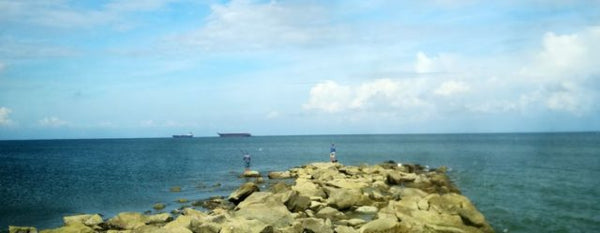
Light jigging from the shore in Bataan
Afternoon Trolling Session
After lunch, we got ready for a light trolling session. Fortunately, my friend had two pre-rigged trolling rods with him. The braid on the main line was at least 0.20 mm in diameter, and the hard mono leader had a diameter of at least 1.00 mm. When trolling, leaders should definitely not be too thin — the lure may scrape along rocks and edges, so good abrasion resistance is essential. The sharp teeth of salt water predators can also cut through thin leaders with ease. Deep-running plugs are the go-to lure, mainly large Rapala plugs of at least 12 cm.
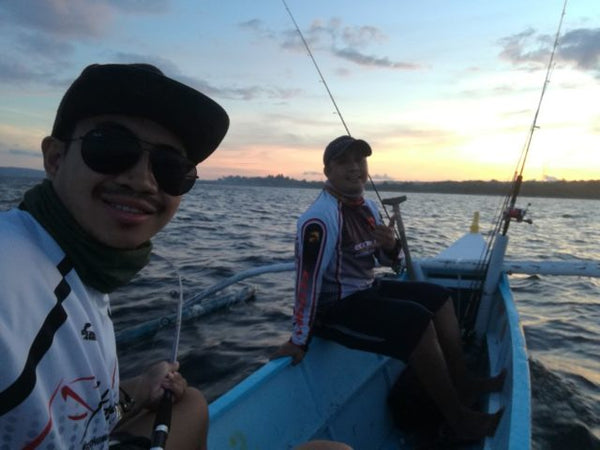
Relaxed trolling at dusk on a 'Banka'
The three of us carried the motorised boat into the water. As the skipper was a local, he knew exactly where the big fish were likely to be. We started trolling parallel to the shore, then headed further out, passing enormous container ships. Shoals of small fish repeatedly broke the surface, fleeing from large predators below. I grew more and more nervous by the minute, but our rods stayed quiet. After around 1 hour, we finally got the first long-awaited bite — but after roughly 5 minutes of fighting, the fish threw the hook on my friend's rod.
We carried on, and I somehow felt drawn to pick up the other rod. I could feel the vibrations of the trolled plug right through to my wrist — I had a good feeling and kept the faith. Sure enough, at dusk, a savage take nearly ripped the rod out of my hands. Then everything happened very fast. From the force of the strike alone I knew it had to be a good fish — and I was right. After a gruelling fight, the fish finally came over the side of the boat. It was a barracuda measuring an incredible 1.24 m. I could hardly believe it. I screamed with joy and then was simply done.
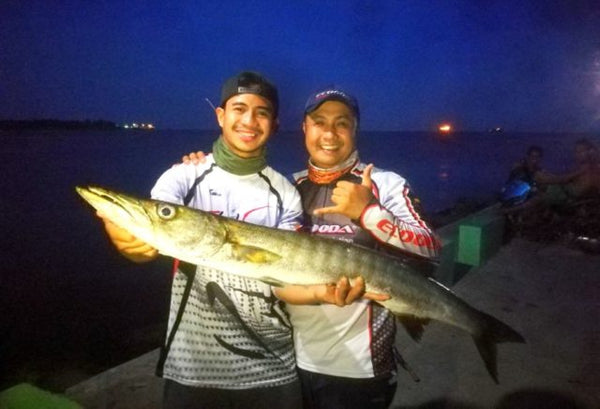
A 1.24 m barracuda, caught trolling at dusk
Salt Water Fishing in the Philippines: Summary
What an unforgettable day — my first proper salt water predator in the Philippines, and what a fish to start with. It doesn't get much better than that. The fish was kept and prepared for the local community to celebrate the occasion. My expectations had been well and truly exceeded.
Tackle:
- Rod: Length: 2.10 m
- Reel: Size: 4000
- Line: Braid, at least 0.2 mm
- Leader: Hard mono, at least 1.0 mm
- Lure: Rapala X-Rap Magnum
For a fee, local fishermen are happy to take you out on a trip. On average, depending on how well you negotiate, you will pay roughly 10–30 euros — depending on whether the boat is motorised and how long you want to be out on the water.
Final Thoughts
Catching a truly special fish in the Philippines is absolutely possible. But as always with fishing, it is never easy. You have to work hard, stay patient, and lean on the knowledge of the locals. Preparation is everything — so match your tackle to the type of fishing and to your target species as well as you can before you go. Be open and ready to gather tips, tricks, and up-to-date information about local waters from the people who know them best. Their local knowledge is invaluable.
Personally, I always find it exciting to explore new waters and target fish I have never caught before. It genuinely broadens your horizons and you pick up new skills every time. I am already looking forward to putting everything I have learned into practice on my next trip.
My target species for future visits will be the giant trevally — also known as GT — and the giant snakehead (Toman). I hope this account and the tips along the way have given you some ideas and inspiration for your next fishing trip to Asia, or perhaps even to the Philippines. Do not hesitate to strike up a conversation with local anglers — they are always pleased to meet anglers from other countries and are more than happy to share their insider knowledge. In the end, we anglers all share the same goal: catch fish and have a great time on the water.
Tight Lines, Bon Jayden Fischkopf