






Almost every still or slow-moving water holds a rich variety of aquatic plants. Everyone knows lily pads and duckweed, and virtually all of you will have had pondweed, milfoil or water starwort stuck to your lure at some point. Their ecological importance is beyond question, yet they often get in the way when you're hunting predators — making some spots, or even entire venues, look unfishable at first glance. Until about two years ago, I'd give these areas two or three obligatory casts with a surface lure at most, or skip them altogether. These days I actively seek out these often under-fished spots, and this year some of my best fish have come from exactly these kinds of places.
Anyone who followed the WPC victory story of Johannes and Dustin will recognise the same theme: soft jerk shads and shallow, weedy water. Here's how I approach this style of fishing and what I bring to the bank.
Theory: Choosing Spots, Season and Target Species
Water Depth
Depending on water clarity, our native aquatic plants colonise not only the margins but also depths of up to 10 metres. All of these zones can be covered with some of the methods described here, but I focus on what are known as the 'floating-leaf' and 'pondweed zones' — that is, areas up to a maximum depth of 6 metres where the plants reach all the way to the surface and are clearly visible.
For me, any area where you can see open patches of water between the plants is worth fishing — somewhere for the lure to actually sit in the water column. Non-predatory species and various insects favour these zones because they offer both food and cover. The same goes for pike, perch and even zander.
Season & Weather
In smaller, very clear or shallow waters, predators can often be found here year-round. In large venues with plenty of deep structure, the months from May to October are when you should never skip these spots. On days with very clear skies and little wind, fish seek extra cover in the weed, turning these areas into double hotspots where fish can seem stacked on top of each other. Warm days in early winter, or just after the close season ends, are also prime weed-fishing days for me — these shallower margins often run 0.5–1°C warmer than the open water when the sun is out.
In lakes where I don't know the depth contours well, I still follow the familiar rule of fishing the windward bank first.
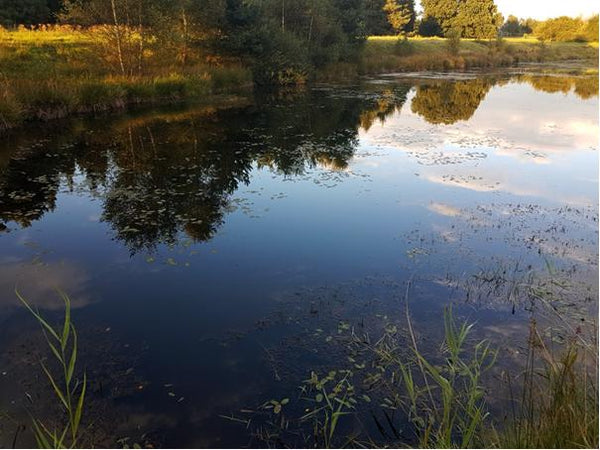
Plenty of room to work: spots like this are never worth skipping!
Hardware: Rod, Reel, Line and Leader
The most important thing when fishing this way is that you don't needlessly expose fish to unnecessary injury — and that you can land them safely. That calls for suitably powerful tackle, since you'll need to steer even big fish through gaps in the weed and keep them coming up throughout the fight. Your line will cut through most plants during the fight, but you have to make sure a hooked fish can't swim around the vegetation. If it does, the extra pressure on the whole system can injure the fish — or cost you it entirely through a hook pull or a break-off.
Rod
For that reason I nearly always use a pike rod with a fairly high casting weight. If it has a modern, mildly progressive or tip-actioned blank, you can still cast lighter lures a good distance with excellent accuracy — and you're not throwing over long distances anyway. My go-to rod for this is 2.10 m long (I have a preference for shorter rods; 2.40 m would probably suit most people better), with a casting weight of 50–100 g and a progressive, fast action.
Reel
I pair it with an equally lightweight Okuma Ceymar C-35 fixed spool reel, which for me represents extraordinary value for money. It's loaded with an approximately 14 kg breaking strain 8-strand braid. That means I can keep the drag almost fully closed to muscle fish safely through the weed.
Leader
The leader choice needs to be suitably robust — you're always going to encounter decent pike here, and they'll happily engulf a lure whole when they shoot to the surface. There's an excellent guide to building leaders on the Pike & Perch YouTube channel:
One more thing to bear in mind: keep your connection as free of 'obstacles' as possible. Pike-proof fluorocarbon, or ideally a wire trace, can be tied directly to the main line with an FG knot, so the only hardware at the business end is a snap.
If you want to stay completely flexible and fish with a swivel at the end of your main line, go for a slightly longer leader to keep any weed that catches on it well away from the lure. Low-memory, kink-free leader material also means you won't have to re-tie after every snag.
Lure Choice and Presentation: From Light Weed to Heavy Cover
Below you'll find the lures I rely on most and their respective strengths and weaknesses. To keep things clear, the list is split into lures for light weed and those built for the proper jungle.
One thing holds true throughout: you don't need monster baits to catch really good fish here.
Big predators will certainly take a larger mouthful when it's on offer, but oversized lures are hard to work through weed without snagging, and my best catches to date have all come on lures up to around 12 cm. My theory is that smaller baitfish are permanent residents of these spots and therefore on the menu for every predator that lives there. The water is also fairly warm during the seasons mentioned, so fish don't need to be particularly selective about what they chase.
Lures for Light Weed
When fishing spots with only scattered plant growth, or outside the main growing season, spinnerbaits, small soft lures on rubber jig heads, and surface lures have all served me well. For surface lures, alongside the classic summer poppers and stickbaits that Kevin has already written about at length, I also make frequent use of the River2Sea Whopper Plopper. Once I've identified a clear lane through the pads, I cast to an open patch and work the lure through it.
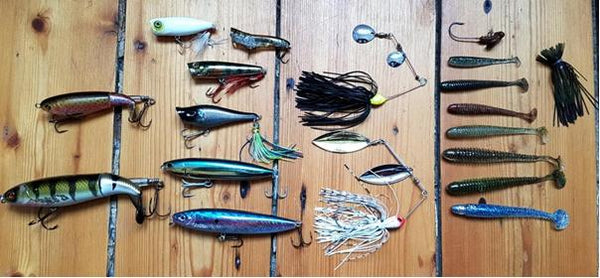
A selection of lures for fishing light weed
Spinnerbaits are a real weapon in summer and autumn among the firmer lily stems and through grass-like vegetation — the wire arm parts the obstacles ahead of the hook and sends out enormous pressure waves, which also makes them excellent search lures. You can easily vary the visual appeal by changing the trailer. If clear lanes are few or a particular spot looks especially promising, you can also let these lures sink to the bottom after a few turns of the handle, then work them slowly along with short hops and pauses.
As a trailer for spinnerbaits and rubber jig heads (these should be weedless or have a bait holder to keep the hook clear of weed), I mainly use slim swimbait-style soft plastics such as the Keitech Swing Impact and the Lunker City Swimming Ribster.
Among surface lures, the Whopper Plopper is probably the least familiar, so a quick note: when targeting perch you can often just crank it through steadily with the odd pause, but for pike I've found it pays to give the lure a short, sharp pull with the rod tip just before stopping the retrieve — enough to make it throw a solid splash of water. Then I leave it dead still for up to 5 seconds. That's usually when the attacks come.

A cracking perch that thankfully came back for a second look after missing the Swing Impact in the lily pad field
Heavy Cover
When a spot is more densely grown — so that you inevitably have to skip over pads or push through fine-stranded algae (often invisible beneath the larger plants until your first cast) — I turn primarily to soft lures on offset hooks, so-called soft jerks, alongside frog imitations.
I fish these with the rod tip held high, varying the speed and adding pauses through the weed, skipping them over floating leaves, and rarely letting them sink more than 20 cm. Hold the rod almost vertical and you can fish soft jerks as subsurface or even surface lures, drawing a nice wake through the vegetation.
In general, any soft lure with a belly slot (an offset pocket) is suitable for an offset hook. Almost more important is a paddle tail set at 90° so the lure still works properly at the surface — tails with a wider angle simply get dragged along without action because there isn't enough water pressure on them. Once I'd worked that out, I started 'tuning' other soft lures to make them offset-ready — more on that at the end of the article.
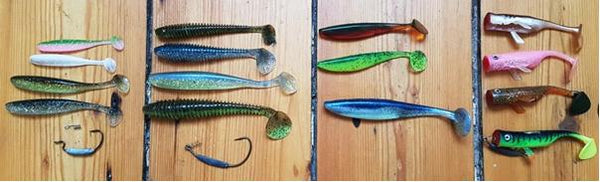
Soft jerk army: Keitech Easy Shiners and Swing Impacts on the left, next to the slightly firmer Swimfish from Lunker City and some tuned Drunk Baits
My choice of soft lure also depends on how dense the weed is. Softer compounds — like those used in the Keitech Easy Shiner or (Fat) Swing Impact — give a great hook-up rate and run incredibly true thanks to the salt on one side, but the hook can sometimes trip on weed contact alone. When that becomes an issue I switch to something with a firmer compound. For 3" lures you'll want a hook in size 1–1/0; for lures up to 4", go for size 3/0. When rigging, make sure the hook point is just barely buried in the body — pull the soft plastic slightly forward at the hook point and pierce it a few millimetres in. On the bite, this releases and the hook pushes up through the lure.
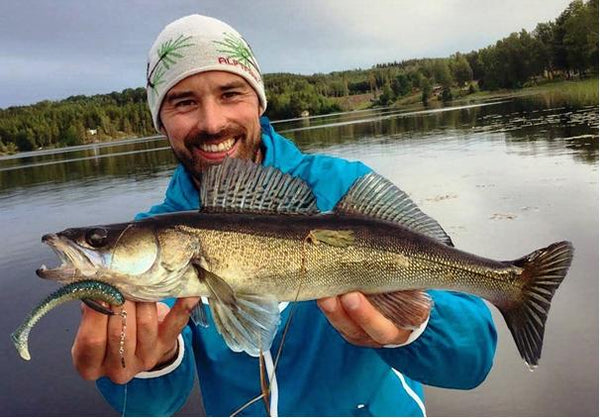
You can even catch zander right in the weed on early evenings or mornings! After a missed attack on a frog, I switched quickly — and the fish was on!
Extra: Lure Tuning and Drunk Baits as Soft Jerks
As mentioned, I also use Drunk Baits for weed fishing. I came to them because their broader body profile and pectoral fins look convincingly fish-like from below, and the very large, steep paddle tail is ideal for surface fishing. An added trigger comes from the wide, almost popper-like head shape, which creates a bubble-trail bow wave that pike in particular seem to love.
To be able to use a sensibly sized offset hook (3/0 fits perfectly), I cut a belly cavity along the underside to the tail root and a short notch of around 1 cm at the top for the hook point. For the belly cavity, follow the visible seam that runs along the sides inside the pectoral fins and across the front third of the body. The head gets a small notch too — roughly 0.5 cm wide and deep. The hook then sits completely weed-free and trips cleanly on the strike. Always test the hook release beforehand, and if needed, work the channel open a little by tripping it a few times. The action becomes even more erratic with an offset hook, and the lure flanks with tremendous life.
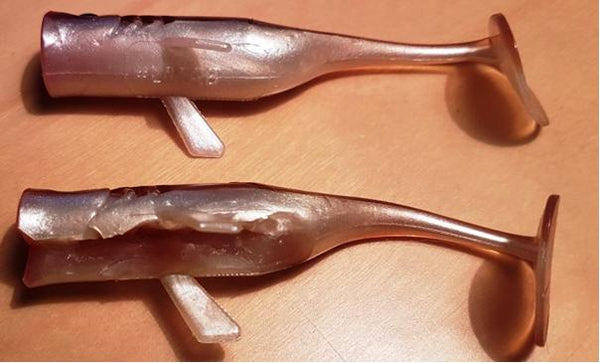
Operation successful — this is roughly what it should look like when you take Drunk Baits into the weed.
All that's left is to wish you tight lines and great catches in the weed! Feel free to leave your questions, experiences and tips in the comments — I'd love to hear them.
Tight lines, Ihno.