






It's been a strange year, all things considered. Thanks to the pandemic, most of us had plenty of time on the water — but plenty of anglers also had to cancel trips they'd been looking forward to for months. At least now you can move about freely again, and why not make the most of what's right on your doorstep? For a short break or a proper holiday, the reservoir system in Germany's largest upland region, the Harz, is an absolute gem for anglers.
In this article I want to give you a clear picture of where to stay, where to buy your day tickets, how to approach these often vast waters, and — most importantly — how to catch fish reliably.
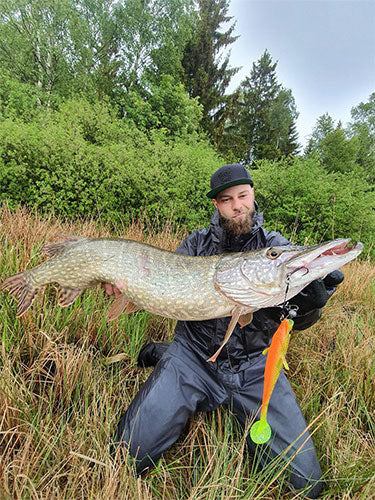
A dream fish from the reservoir — with patience and the right technique, by no means a rare occurrence!
Reservoirs in the Eastern Harz — The Rappbode System
There are quite a few reservoirs in the Harz. The best known are probably the Okertalsperre, the Oderstausee and the Rappbodetalsperre. To keep things manageable, this article focuses on the reservoirs of the Rappbode system in the eastern Harz — though most of the tips and tactics here apply equally well to other reservoirs in the region.
If you're planning more than a day trip, the towns of Elbingerode and Wernigerode have plenty of affordable and comfortable accommodation. A guesthouse close to the water can also be found in Königshütte, at the 'Zum Felsen' pension — a solid base for your tours around the Harz reservoirs.
Buying Day Tickets in the Harz
Day tickets cost €15 and are available from the tourist information offices in Elbingerode, Hasselfelde and Benneckenstein, or from the 'Fressnapf' pet shop in Wernigerode. For the Zillierbachtalsperre, near Wernigerode, tickets can now also be purchased online at www.fiskado.de.
You can also pick up your parking permit at the tourist information offices.
In Saxony-Anhalt you're permitted to drive along most forest tracks to reach designated angler car parks. It's not far from these to the water's edge, and there are even dedicated disabled parking and fishing spots. The information offices can tell you exactly where to find them.
How Does the Rappbode System Work?
The Rappbode system consists of several reservoirs of varying sizes, nearly all of which serve as drinking water supplies. Water quality is consequently excellent, and the water tends to be very clear.
The most productive waters for lure fishing are, first and foremost, the Rappbodetalsperre itself. Its sheer size — combined with a ban on boat fishing — can make it feel almost impossible to crack from the bank. But the tips below will put you on fish. Bear in mind that this reservoir reaches depths of 60 m.
The most productive areas are therefore towards the upper reaches of the reservoir, where the water shallows out and the bays become smaller and more feature-rich. The approach via Hasselfelde, the Hasselvorsperre, and the pre-reservoir at Trautenstein are all well worth exploring.
Around the village of Königshütte you can also fish the 'Trogfurther Brücke' reservoir and the Mandelholz flood retention basin. Both are ideal for day sessions thanks to their manageable size and healthy fish stocks, and neither requires too much walking. Boat and float tube fishing are prohibited on both.
Boat Hire at Wendefurth
The Wendefurth reservoir is a special case. As it's not used for drinking water, you can hire a rowing boat here for €10 a day. That said, bank fishing here can be just as rewarding.
The boat hire is generally open from Easter through to mid-October. This reservoir is also a great option if you're bringing the family along — alongside pedalos and a restaurant, there's one of the world's longest suspension bridges and a mega zip line to enjoy.
Tactics and Tips for a Successful Day
Before I get into the specifics for each target species, a few general points worth knowing:
All the reservoirs in the Rappbode system share a similar profile — think of a bathtub. Follow the bank and it becomes obvious: the margins drop away steeply after just a few metres, then level off into a flat bottom that extends to the far bank. On the face of it, there's very little in the way of structure, and weed is scarce almost everywhere thanks to the stony substrate. What you do get, however — especially along the margins — is plenty of deadwood and old tree stumps. These give the reservoirs a character all of their own and are the key features to target.
It's also worth having waders with you, particularly in spring, late autumn and winter. When water levels are high, an extra metre or two of casting range can make all the difference. Now let me turn to each target species and the methods that work best for them. Since boats and float tubes are banned on most of these reservoirs, I'll focus entirely on bank fishing techniques.
Pike in the Reservoirs: Margin Fishing to Open-Water Monsters
Pike are arguably the number one target species here. They're the most straightforward to catch, and when conditions align, a fish of a lifetime is genuinely on the cards.
First things first:
Find the wind!
Without a decent blow on the water, getting one of the big reservoir pike to bite is genuinely tough. A force 4 is ideal — without it, too much unbroken light penetrates the very clear water and the fish often switch off completely.
The pike season in the Harz officially opens on 1 May, but it's not unusual for winter to linger here longer than elsewhere, meaning pike don't really get going until the second week of May. At that point, target the shallower areas of the reservoir, always close to where the River Bode enters — waders are pretty much essential here given the water levels. Soft lures in the 14–20 cm range work very well in the shallows, and spinnerbaits, chatterbaits and glidebaits all account for fish too. Early in the season you can afford to go brighter with your colours — the pike are aggressive and hungry. From late May onwards, fish spread back out across the whole reservoir.
For the rest of the year, your bread-and-butter pike come from just beneath the margins. With so little cover elsewhere, they sit tight to the bank and use the deadwood and old stumps for shelter. Fish mid-sized soft lures and shallow-running plugs here to work your lure right over the top of the structure. Smaller and mid-sized pike will also take small soft lures on the drop when you're jigging, so always use a wire trace when perch fishing too. Classic lures like spoons and spinners rarely produce in the Harz these days — the locals have been fishing them for too long.

A proper wind and a cast along the margin produced this fine pike. The KØFI in 18 cm in Ghost Perch is almost always worth a try.
If you want to target genuinely big pike deliberately, the rule applies year-round: big lures are non-negotiable. Even if it means blanking for an entire day, fishing lures of 18 cm and above through open water is the most effective way to bank a truly large pike from the shore. In winter you can go a size smaller, but from late May through to late November, the 'big mamas' typically take in around two metres of depth.
Perch Fishing — Quality Over Quantity
Catching a good Harz pike is one thing — tracking down the really big perch is considerably harder. It's still very much worth targeting perch in the Harz, though; in my experience, you rarely catch one under 35 cm here, which tells you something about the average size.
Your best chances come between June and mid-to-late November. The key is to cover ground. Perch in the Harz reservoirs tend to be spread out, and after catching one fish from a spot it's often the only one you'll get there.
Like pike, perch sit tight under the margins, using the structure and deadwood for cover. The most effective approach is to work small soft lures between 7 and 10 cm slowly through the area, or to use twitchbaits. In clear water, perch respond well to long pauses during the retrieve — not just in cold conditions.
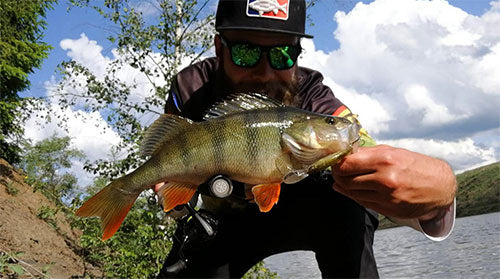
Twitch, twitch, pause… that's exactly when the perch came shooting out of the branches to take the twitchbait.
The biggest perch, however, are best found by jigging (watch out — pike are always a possibility here, so always use a wire trace).
Perch here seem to have adapted to the lack of structure — they're very often found close to the bottom, roaming actively.
Experience shows that in the shallower reservoirs it pays to start your search near the dam wall and work your way towards water around 2.5 m deep. In the Rappbodetalsperre, focus on the smaller bays in the upper reaches.
Lure sizes between 7 and 12 cm work best, with jig heads in the 7–14 g range. Natural colours are always reliable, but Motoroil and GPC consistently account for good fish too.
The hottest times of day are undoubtedly dawn and dusk. Deep into winter, perch become increasingly difficult — they drop so deep that fishing for them effectively becomes impractical.
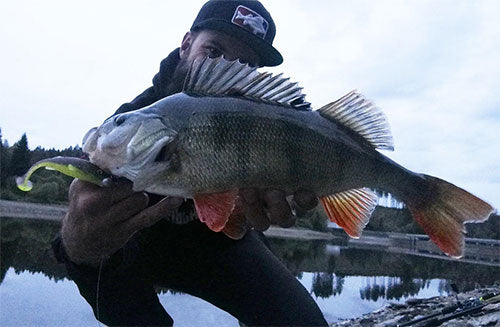
The magical 40 cm mark broken just before dark — thanks to the KØFI Perch in GPC!
Zander in the Harz Reservoirs — Difficult, but Not Impossible
Over recent years zander have been stocked in these waters. Populations in the Rappbodetalsperre and the Wendefurth reservoir are now fairly healthy, but they remain difficult to catch — the water is too clear and often too cold.
If you do want to target them, wait for overcast, murky conditions and use lighter jig heads. In my experience, smaller soft lures under 10 cm tend to be more productive. Depending on the season, zander can be found quite shallow (summer) or relatively deep (winter). As with perch, dusk is prime time — but night sessions also produce results, and slowly worked plugs fished beneath the margin, as you might fish a river, can be deadly.
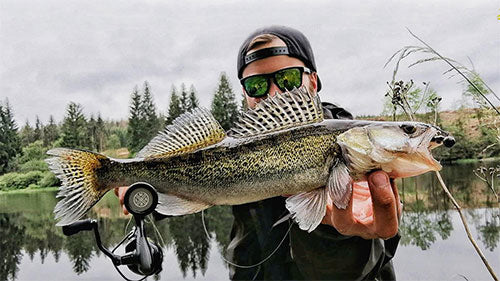
A light jig and small lure unlocked this zander from the reservoir on a grey, overcast day.
Brown Trout, Lake Trout and Rainbow Trout — Fly and Lure Fishing for Salmonids
One of the real highlights of this reservoir system is the outstanding salmonid fishing. In the Rappbodetalsperre, brown trout and lake trout are on the cards at any time of year. The other three reservoirs covered in this article hold excellent rainbow trout stocks, restocked several times annually by the local clubs, so there's always a decent trout to be had. Your best chance is in April, when all other predators are still out of season. Small soft lures and spoons worked shallow are the most reliable approach.
The Mandelholz reservoir in particular lends itself beautifully to fly fishing — I've had some memorable silver-and-gold days there. Black and brown streamers work best. A class 5 rod with a floating line is ideal.

A classic black Woolly Bugger did the trick here.
Wrapping Up
I hope this article has sparked your interest in the Harz. The fishing here is genuinely varied, and there's plenty to keep the whole family busy too. If you have any questions, drop them in the comments or get in touch with me on Instagram (glimmi_lmab). I'm always happy to head out to the water with you!
Tight lines, Gunnar